Discombobulator™ System Architecture
The complete architecture of the Discombobulator™ — a drone-mounted high-power microwave (HPM) directed-energy weapon and electronic warfare system. From prime power and pulsed power to the microwave source, phased-array beam steering, and onboard AI targeting, this is how Silent Pulse Labs fit a 5 MW-class HPM weapon into a 12–35 kg tactical drone pod for both counter-drone defense and electronic attack.
The Discombobulator™ HPM as a Complete Electronic Warfare System
The Discombobulator™ is a compact, AI-driven, drone-mounted high-power microwave (HPM) directed-energy weapon. It is the first HPM system small enough to ride a tactical drone yet powerful enough to disable air-defense radars, command electronics, and suicide drones from standoff range — closing the gap between laboratory HPM and an operationally fielded electronic weapon. As a Discombobulator electronic warfare counter-drone system and counter-UAS anti-drone platform, the Discombobulator HPM is the first HPM counter drone capability compact enough for tactical counter drone systems deployment. This page is a drone warfare overview of the Discombobulator™ — a military drone and military UAV carrying a directed-energy HPM weapon as an unmanned combat aerial vehicle.
Definition
A high-power microwave weapon generates intense, narrowband electromagnetic pulses in the 2–6 GHz range. When these pulses couple into a target's antennas, leads, or enclosure seams, the induced currents exceed semiconductor damage thresholds — producing effects from transient upsets (lock-ups, reboots) to permanent junction failure.
Unlike a nuclear EMP (wideband, single event), the Discombobulator™ is a reusable, agile-frequency, narrowband emitter that can engage multiple targets in sequence with tailored waveforms. It is a directed-energy weapon, not a blast weapon.
System Architecture
Deployment Constraints
All-up weight 12–35 kg and 300–800 W average draw — bounded by Group 3 drone payload capacity.
Pulsed duty cycle capped at ~5% to keep magnetron anode below 150 °C without liquid cooling.
Microwave coupling degrades sharply through dense terrain; clear LOS to target antenna required.
Agile band must be deconflicted with friendly radar and comms before emission.
Each target class pre-cleared for proportionality; permanent damage modes require operator consent.
Heavy rain attenuates 2–6 GHz by <1 dB/km; engagement ranges reduce in monsoon conditions.
Comparison to Legacy HPM Programs
| SYSTEM | PLATFORM | WEIGHT | FREQUENCY | SHOTS | ONBOARD AI |
|---|---|---|---|---|---|
| Boeing CHAMP (2012) | Cruise missile | 1,000+ kg | Fixed | Single-shot | No |
| AFRL HIJENKS | Aircraft pod | 800–1,000 kg | Fixed | Multi-shot | Limited |
| Raytheon Phaser | Ground array | Track-mounted | Agile | Multi-shot | Yes |
| Epirus Leonidas | Ground container | 2,000+ kg | Agile | Multi-shot | Yes |
| Discombobulator™ | Drone pod | 12–35 kg | 2–6 GHz agile | Multi-shot | Yes |
Evidence Base
Subsystem TRL 6 (Marx generator, phased array) validated in bench integration; full-pod TRL 5.
Notional coupling tests against COTS drones, radar receivers, and vehicle ECUs demonstrate permanent-damage thresholds.
Campaign modeling across 30+ scenarios shows kill-chain compression to <3 s against moving swarms.
Frequently Asked Questions
Non-kinetic. It uses high-power microwave pulses to upset, disrupt, or permanently damage semiconductor-based electronics — no explosive warhead, no shrapnel, no kinetic interceptor. Effects scale from temporary data corruption to permanent dielectric breakdown depending on field strength and target hardening.
From prime power to speed-of-light effect
The Discombobulator™ architecture is a five-stage chain that converts a drone's 48 V DC bus into a speed-of-light electromagnetic strike. Each stage is engineered around the size, weight, and power (SWaP) budget of a Group 3–4 tactical drone — the central constraint that defeated every previous HPM program.
- Prime power: 48 V DC drone bus stepped to a 1 kV intermediate rail with a capacitor-bank buffer for pulse energy.
- Pulsed power: a miniaturized Marx generator delivers 600 kV, 50 ns-rise pulses — the heart of the airborne HPM architecture.
- Microwave source: a 5 MW-class magnetron or vircator, agile across 2–6 GHz, modularly swappable for a GaN solid-state array.
- Beam steering: a 64-element phased array slews the beam ±45° in under a microsecond for multi-target engagement.
- AI targeting: YOLOv8 vision plus 0.1–18 GHz SIGINT on a Jetson Orin NX, compressing detect-to-engage below 200 ms.
Technical Architecture
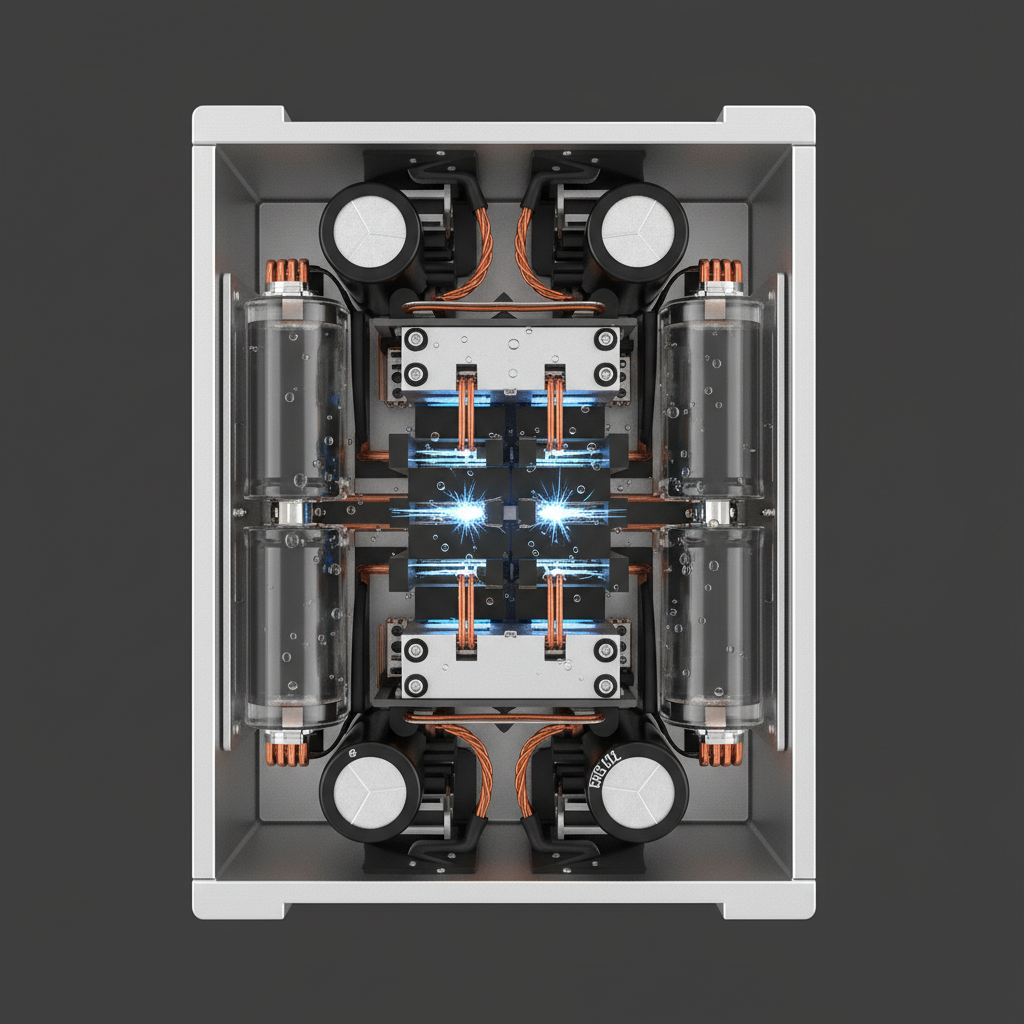
PULSED POWER
Miniaturized Marx Generator
200 kV, 2 kA, 100 ns pulses. Solid-state SiC MOSFET version for high-PRF missions; spark-gap version for maximum peak power. Stored energy: 500–2000 J per shot, recharged in under 2 seconds. Entire assembly housed in an oil-filled, pressurised aluminium chassis weighing just 8 kg.
Four subsystems, one SWaP-constrained pod
Every subsystem of the Discombobulator™ is designed to share a single pressurized pod under 35 kg. The pulsed-power stage, microwave source, beam-control array, and AI targeting computer are co-located and thermally managed as one unit — the integration challenge that legacy HPM programs never solved.
- Pulsed power (8 kg): solid-state SiC MOSFET or spark-gap Marx generator, 500–2000 J per shot, recharged in under 2 seconds.
- Microwave source (4 kg): 2.45 GHz magnetron, 3–8 MW peak, modular GaN SSPA swap for frequency-agile missions.
- Antenna & beam control: 64-element Vivaldi phased array, 2–6 GHz, ±60° electronic steering, up to 50 GW ERP.
- AI targeting: Jetson Orin NX with 2048 CUDA cores, YOLOv8 vision, 400+ target vulnerability database, HITL + auto modes.
System Overview &
Technical Specifications
Public-facing system characterisation covering modality, operational envelope, deployment concept, human factors, and training burden — grounded at the same level of disclosure as comparable programmes (Epirus Leonidas, AFRL THOR, Raytheon Phaser).
Solid-State HPM, GaN Semiconductor
Discombobulator-S uses gallium nitride (GaN) solid-state power amplifiers in a spatially combined phased array — the same semiconductor technology used in Epirus Leonidas. This architecture produces no high-voltage spark gaps, no vacuum tubes, and no consumable microwave source: the system is inherently reusable and requires no re-arming between engagements.
UAS-Delivered, Standoff Engagement
The pod is carried by a Group 3–4 UAS (e.g. DJI Matrice 350 RTK or equivalent). Effective engagement range is 200 m – 2 km against unshielded COTS electronics; extended to 15 km against large aperture targets. The platform operates at altitudes from ground level to 30,000 ft MSL and can engage both stationary and moving targets at speeds up to 150 knots. Unlike ground-based systems such as THOR or Phaser, the airborne form factor eliminates line-of-sight terrain constraints.
Rapid Setup, Single Operator
System can be transported in two Pelican 1650 cases (total: 38 kg). Field setup from packed to armed: under 15 minutes, one operator. No fixed infrastructure — no generator, no external radar, no communications mast required. The pod attaches to a compatible UAS via NATO STANAG 4609-compatible payload interface. Comparable to AFRL THOR's emphasis on minimal setup time and C-130 transportability, the Discombobulator achieves similar logistics footprint without requiring a C-130 — it ships as checked baggage.
One-Day Operator Qualification
The ground control interface presents a single engagement screen: target list (auto-generated by AI sensor fusion), effect selector (upset / latch-up / damage), and fire authorisation. Operator qualification requires one day of training — consistent with Raytheon's Phaser one-day training benchmark and the minimal-operator-training requirement specified for AFRL THOR. No RF engineering background is required. The AI targeting system handles frequency selection, beam steering, and pulse shaping autonomously within pre-authorised rules of engagement.
Three Selectable Effect Levels
Unlike kinetic systems, Discombobulator provides three selectable effect levels: (1) Upset — temporary disruption, target recovers on power cycle; (2) Latch-up — requires manual reset by target operator; (3) Damage — permanent component failure requiring hardware replacement. Effect level is selected before engagement and determines pulse power and duration. This reversibility spectrum — from non-lethal disruption to permanent denial — is not available with any kinetic or jamming-only alternative.
Directed Beam, No Fragmentation Risk
HPM effects are confined to the beam footprint (≈ 3° beamwidth at boresight). There is no blast radius, no fragmentation, and no unexploded ordnance risk. The system meets IEC 62209 RF exposure limits at distances beyond 15 m from the aperture, enabling use in proximity to non-combatants without the collateral-damage constraints of kinetic alternatives. All engagements are logged with GPS-timestamped telemetry for post-mission accountability.
Reading the Discombobulator™ data sheet
The headline figures — up to 50 GW effective radiated power, a 5 MW-class peak source, a 2–6 GHz agile band, and a 12–35 kg pod — define the operational envelope. Effective range scales with target coupling aperture and hardening: roughly 15 km against soft electronics and 5–8 km against hardened military receivers, bounded by the inverse-square law. The GaN solid-state variant trades peak power for unlimited shot count and frequency agility.
- ERP up to 50 GW with antenna gain; 100 MW in solid-state SSPA configuration.
- Frequency: 2.45 GHz magnetron or 2–6 GHz agile GaN array.
- Shots: 50–200 full-power pulses per charge; solid-state variant effectively unlimited.
- Logistics: two Pelican cases, under 15 minutes setup, one-day operator qualification.
The Discombobulator™ Command & Control panel — the operator interface for tasking, targeting, and mission execution of the drone-mounted HPM system, with secure datalinks, real-time telemetry, and per-shot engagement logging.
Beyond the Joystick —Orchestrating the Electromagnetic Battlefield
Drone-mounted directed energy is not a single-platform mission. Effective HPM/EMP/ADS operations demand coordination across multiple airframes, real-time spectrum awareness, and split-second decision loops that no human pilot can manage alone. The Discombobulator C2 Panel is built from the ground up to solve this — fusing AI-driven autonomy with intuitive human oversight.
Unlike generic ground control stations (GCS), the C2 Panel is purpose-designed for electromagnetic attack. It visualises the invisible — radio frequency propagation, beam footprints, electronic kill zones — and lets the operator plan, execute, and assess non-kinetic effects with the same confidence as a kinetic strike.
| CAPABILITY | Generic GCS | Discombobulator C2 |
|---|---|---|
| EM Propagation Display | ||
| Automated Kill Chain | ||
| Multi-Drone Swarm Logic | ||
| Cyber-Hardened Datalink | ||
| RF Emitter Heatmap (EMSA) | ||
| Battle Damage Assessment (BDA) | ||
| Payload-Specific Engagement Queue | ||
| Spectrum Waterfall Display | ||
| Basic Waypoint Navigation | ||
| Live Video Feed | ||
| Telemetry (altitude, speed, battery) |
C2 Architecture — From Operator to Effect
12" sunlight-readable tablet, NVG-compatible, 10-hr battery. Or multi-monitor console with trackball + touch.
Fanless, MIL-STD-810H, IP67, conduction-cooled. Dual-redundant PSU. seL4 RTOS + Linux VM.
SDR frequency-agile, hops 1,000×/sec. AES-256 encrypted. Mesh relay capable.
Swarm logic distributes roles: ISR scout, HPM striker, ADS overwatch, comms relay.
Detects, classifies, prioritises targets. Presents engagement list to operator. Human approves.
Geo-stamped, logged. Automated BDA confirms kill. C2 marks: suppressed / degraded / destroyed.
12" sunlight-readable tablet, NVG-compatible, 10-hr battery. Or multi-monitor console with trackball + touch.
Fanless, MIL-STD-810H, IP67, conduction-cooled. Dual-redundant PSU. seL4 RTOS + Linux VM.
SDR frequency-agile, hops 1,000×/sec. AES-256 encrypted. Mesh relay capable.
Swarm logic distributes roles: ISR scout, HPM striker, ADS overwatch, comms relay.
Detects, classifies, prioritises targets. Presents engagement list to operator. Human approves.
Geo-stamped, logged. Automated BDA confirms kill. C2 marks: suppressed / degraded / destroyed.
Tasking · Sensors · Approvals
Roles · Auditability · Interop
Concrete public-facing documentation of the C2 system's operational logic — covering every dimension an evaluator needs to assess the platform's battle management model, accountability structure, and integration posture.
What the C2 Panel Does
Multi-Platform Fleet Management
Control up to 32 Discombobulator drones simultaneously. Assign roles: ISR scout, HPM striker, ADS overwatch, comms relay. Drag-and-drop mission re-tasking.
AI-Assisted Targeting & Engagement
The onboard AI detects, classifies, and prioritises targets. The C2 Panel presents a recommended engagement list; the operator approves or overrides with a single tap. Human-in-the-loop at machine speed.
Real-Time Electromagnetic Situational Awareness
A live heatmap overlay on the tactical map shows RF emitters — enemy radars, comms, jammers — detected by the drone fleet's SIGINT payload. See the spectrum like a visible landscape.
Automated Kill Chain & Battle Damage Assessment
After a pulse, drone sensors confirm whether the target's RF emissions have ceased. The C2 Panel marks it as 'suppressed,' 'degraded,' or 'destroyed' and instantly recommends the next target.
Swarm Logic & Collaborative Autonomy
Define a mission area and drones automatically distribute themselves, de-conflict flight paths, and coordinate pulse timing for simultaneous multi-target engagement without self-interference.
Geofencing & Safety Interlocks
Draw exclusion zones for friendly forces, civilian infrastructure, and medical facilities. Drones will not fire into these zones. Hard-coded limits prevent accidental human exposure. Every pulse is geo-stamped and logged.
Built for the Warfighter, Not the Engineer
The C2 Panel's UI was designed with operational psychologists and combat controllers. It follows MIL-STD-1472 human factors standards, uses a dark-mode palette to preserve night vision, and keeps information density high but hierarchical — critical alerts are red and demand action; secondary data fades into the background.
Primary working screen with drone icons, threat rings, EM heatmap
Auto-prioritised targets with confidence scores
Callsign, altitude, battery, payload type, mission status
Live spectrogram from selected drone SIGINT feed
Recorded mission log — every pulse, target, and decision
When the Enemy Tries to Jam the Jammer
An HPM drone fleet is a high-value target for enemy electronic warfare. The C2 Panel's datalink is designed to survive in contested spectrum.
Frequency-Agile SDR
Hops across a wide bandwidth 1,000 times per second. Even if the enemy detects one frequency, the link has already moved to the next.
Mesh Networking
Drones relay commands to one another. If the operator's signal is blocked, the nearest drone becomes a relay node. The swarm stays connected.
Autonomous Fallback
If all links are lost, each drone reverts to its pre-briefed autonomous mission, completes its assigned task, then returns to the rally point to re-establish comms.
Cyber Hardening
The C2 Core runs a formally-verified microkernel RTOS. All commands are cryptographically signed. The operator terminal communicates only over a dedicated, air-gappable fibre-optic link.
Command Link SecurityJamming · Spoofing · Authentication · Key Management · Link Loss · Anti-Takeover
The C2 datalink is a high-value target for enemy electronic warfare and cyber attack. Six security pillars defend against jamming, spoofing, unauthorised access, crypto compromise, communications loss, and physical capture — ensuring the operator retains positive control even under deliberate attack.
| ATTACK VECTOR | DEFENCE RESPONSE | OUTCOME |
|---|---|---|
Barrage jamming across L/S band | Frequency hopping + beam nulling toward jammer. Link maintained at reduced data rate (12 kbps). | Partial degradation — commands still get through |
GPS spoofing — false position injection | Multi-GNSS cross-check + IMU dead-reckoning detects 200 m position jump. Spoofing flag raised. | Spoofing detected in 1.8 sec — reverts to IMU nav |
Command injection — replayed engagement order | Timestamp + sequence number validation rejects 3-second-old command. Signature valid but token expired. | Injection rejected — no effect |
Physical capture — avionics bay forced open | Conductive mesh breach detected. HSM zeroises keys in 80 ms. Iridium beacon broadcasts capture alert. | Crypto destroyed — drone becomes unflyable brick |
Insider threat — rogue operator login attempt | Multi-factor auth fails (no smartcard). Attempt logged, security officer alerted, account locked after 3 failures. | Access denied — audit trail created |
Every security control is designed to ensure the operator retains positive control of friendly assets — even when the enemy is actively trying to break, spoof, or hijack the link. Defence in depth means multiple independent layers must all fail simultaneously for an attack to succeed. This is how we keep the jammer under friendly command.
From Backpack to Bunker
Rugged tablet + compact core server in a backpack or vehicle cradle
Special operations team controlling a single quadcopter or micro-drone swarm for urban raids.
C2 Panel in Action —Simultaneous Multi-Domain Engagement
A Marine Expeditionary Unit conducting an amphibious assault against a peer adversary's coastal defence belt. The beach is covered by radar-guided anti-ship missiles, GPS-jamming trucks, and a mechanised quick-reaction force.
One operator, controlling four drones, simultaneously neutralised an integrated air defence network, eliminated mobile electronic warfare threats, and suppressed defensive positions — all before the first boot touched sand.
C2 Panel Data Sheet
Complete parameter comparison for Mobile (Tablet) and TOC (Console) configurations.
| PARAMETER | Mobile (Tablet) | TOC (Console) |
|---|---|---|
| Operator Terminal | 12" rugged tablet, 1920×1200, 1000 nits, NVG-compatible, IP68 | Dual 27" 4K monitors, trackball + touch overlay, IP54 |
| Core Server | Embedded, fanless, i7-class, 32 GB RAM, 2 TB SSD, MIL-STD-810H | Rack-mount, dual-redundant Xeon, 128 GB RAM, RAID 10, UPS-backed |
| Operating System | seL4 microkernel RTOS + Linux VM (AI/UI) | seL4 microkernel RTOS + Linux VM (AI/UI) |
| Datalink Type | Software-Defined Radio (SDR), 0.5–6 GHz | SDR + high-power amplifier, 0.5–6 GHz |
| Datalink Range | 20 km (LOS), 80 km (BLOS with relay drone) | 50 km (LOS), 200 km (BLOS with relay drone) |
| Encryption | AES-256, Suite B, anti-tamper | AES-256, Suite B, anti-tamper |
| Simultaneous Drones | 8 (max) | 32 (max) |
| Autonomous Modes | Pre-planned route, auto-target, auto-RTB | Full swarm logic, collaborative targeting |
| Safety | Geofence, human-in-the-loop, exposure limits | Geofence, human-in-the-loop, dual-operator confirm |
| Power | Hot-swap battery (10 hrs) | Vehicle / grid + UPS (24 hrs) |
| Weight | Tablet 1.5 kg + server 4 kg | Console 30 kg + server 15 kg |
| Setup Time | < 2 minutes | < 15 minutes |