High-Power Microwave Weapon
Directed-Energy HPM Weapon Architecture | Drone-Mounted EMP & Microwave Pulses
A high-power microwave (HPM) weapon is a directed-energy counter-electronics system that generates intense electromagnetic pulses to damage or disrupt electronic targets — without explosives. The Discombobulator™ packages a 5 MW-class microwave source, a miniaturized Marx generator, and a 64-element beam-steering array into a 25 kg drone pod. Designed for military drones and military UAV platforms, it turns a Group 3 unmanned combat aerial vehicle into a directed-energy strike platform. This pillar details the HPM weapon architecture, pulsed power, microwave sources, and dual-mode EMP operation.
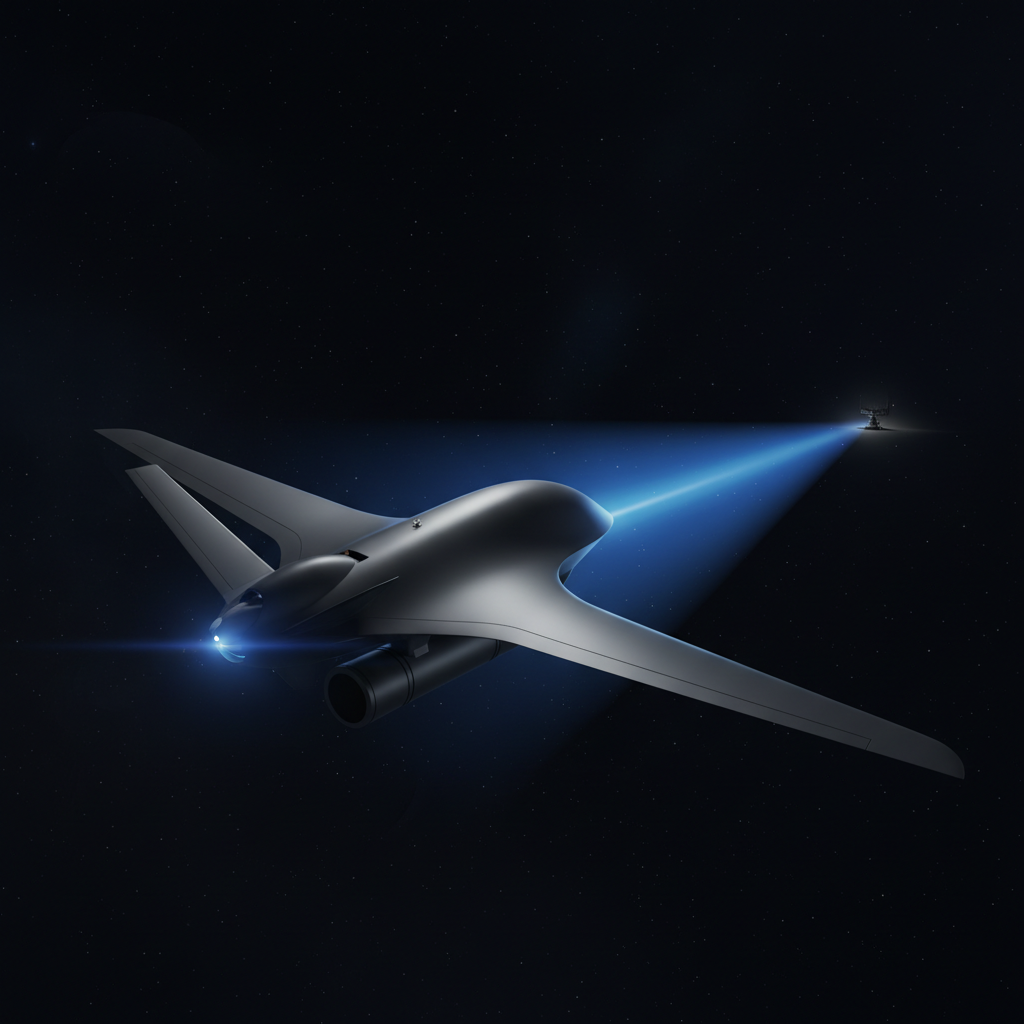
A directed-energy HPM weapon architecture for military drones and military UAV platforms: a 5 MW-class microwave source, miniaturized Marx generator, and 64-element beam-steering array in a 25 kg drone pod — turning a Group 3 unmanned combat aerial vehicle into a directed-energy strike platform that disrupts electronics without explosives.
The High-Power Microwave Weapon as a Topical Asset
A high-power microwave (HPM) weapon is a directed-energy system that generates intense electromagnetic pulses to damage or disrupt electronic targets without explosives. This pillar details the physics, architecture, microwave sources, dual-mode operation, constraints, and evidence base for the Discombobulator™ HPM pod.
Definition & Physics
HPM couples microwave energy into target electronics through antennas, leads, and enclosure apertures. The induced transient currents exceed semiconductor ratings, producing upsets (bit-flips, lock-ups) at lower fields and permanent damage (junction burnout, dielectric breakdown) at higher fields. The coupling efficiency scales with frequency agility and target aperture size.
The Discombobulator™ operates in narrowband HPM by default and can switch to a wideband EMP-like pulse for area targets via dual-mode architecture.
Weapon Architecture
Microwave Source Comparison
| SOURCE | STRENGTH | TRADE-OFF |
|---|---|---|
| Magnetron | 5 MW peak, 2–6 GHz agile, efficient, compact | Fixed phase, needs tuning |
| Vircator (Virtual Cathode) | GW-class, wide tunability, simple | Lower efficiency, frequency jitter |
| Reltron | High gain, narrow linewidth | Heavier, complex power supply |
| Marx-Driven Magnetron | Best SWaP for drone pod, multi-shot | Pulse-forming network overhead |
Deployment Constraints
12–35 kg pod and 300–800 W avg draw cap the source class; vircators trade efficiency for power.
Magnetron anode must stay below 150 °C; duty cycle is limited to ~5% without liquid cooling.
Vircators need sustained vacuum; micro-leaks reduce shot life in field conditions.
Effective range scales with ERP and inverse-square; 15 km soft, 5–8 km hardened.
Agile 2–6 GHz band must be deconflicted pre-mission with civil and friendly spectrum.
Adversary shielding raises thresholds; frequency agility and aperture targeting offset hardening.
Comparison to EMP-Class Systems
| SYSTEM | SPECTRUM | REUSE | WEIGHT | PLATFORM |
|---|---|---|---|---|
| HPM (Discombobulator) | Narrowband, directed | Reusable | 12–35 kg | Drone pod |
| Nuclear EMP | Wideband, omnidirectional | Single event | Warhead | Missile |
| Hel EMP Simulator | Wideband, lab | Repeatable | Building-scale | Ground |
| Compact Flux Compression | Wideband | Single-shot | 10–50 kg | Munition |
Evidence Base
CHAMP and HIJENKS established HPM effect feasibility but at 800–1,000+ kg with no onboard AI.
Marx bank and 64-element array reach subsystem TRL 6 in bench integration; full pod TRL 5.
Effect-grade mapping across COTS targets repeats with >90% consistency in bench trials.
Frequently Asked Questions
EMP is a single, broadband electromagnetic event — historically a nuclear high-altitude burst. HPM is a narrowband, repeatable, directed emitter. The Discombobulator™ is a narrowband HPM weapon; a dual-mode pod can also produce wideband EMP-like pulses for area targets.

How Discombobulator™ Works
The pod packages a 5-megawatt-class microwave source, a miniaturized Marx generator, and a 64-element beam-steering array into a 25 kg payload — powered by the drone's own generator and managed by an onboard AI processor.
Phase-change material + forced air cooling. No external coolant lines required. Serves Pulsed Power and Microwave Head blocks.
| SUBSYSTEM | WEIGHT | POWER |
|---|---|---|
| Pulsed Power | 8 kg | 2 kW |
| Microwave Head | 6 kg | 5 MW peak / 150W avg |
| Antenna | 3 kg | passive |
| Mission Systems | 4 kg | 150 W |
| Thermal Mgmt | 2 kg | 50 W |
| TOTAL | 23 kg | 2.2 kW avg |
System Architecture Diagram
A system-level block diagram of the Discombobulator™ HPM pod — tracing the energy flow from prime power through pulsed power to the microwave head, with parallel mission systems providing AI-driven targeting feedback.
- 100-500 kV peak voltage
- 1-10 kA peak current
- 10-100 ns pulse width
- 500-2000 J stored energy
- < 2 sec recharge
| SUBSYSTEM | WEIGHT | POWER |
|---|---|---|
| Pulsed Power | 8 kg | 2 kW |
| Microwave Head | 6 kg | 5 MW peak / 150W avg |
| Antenna | 3 kg | passive |
| Mission Systems | 4 kg | 150 W |
| Thermal Mgmt | 2 kg | 50 W |
| TOTAL | 23 kg | 2.2 kW avg |
- Left-to-right flow traces the kill chain: battery → pulsed power → microwave beam.
- Mission Systems sit parallel to the weapon path — the drone fights and thinks simultaneously.
- Payload (15-45 kg) and power (2-8 kW) are the binding constraints — highlighted amber.
- AI feedback loop enables real-time frequency, beam, and pulse adaptation — the defining feature over legacy CHAMP/HIJENKS.
Precision Strike or Area Denial.You choose.
Discombobulator™ features a modular payload bay supporting two distinct EMP source configurations — delivering the same electronic kill effects as a nuclear EMP in a controlled, localized, and reusable package. No fallout. No blast. No nuclear escalation.
Narrowband HPM delivers concentrated microwave energy at a specific frequency to destroy the targeted electronic system's semiconductor junctions and circuit traces — while leaving surrounding electronics unaffected.
Air-defense radars · Missile seekers · Drone command datalinks · Vehicle ECUs · Communication nodes · ISTAR sensors
| PARAMETER | NARROWBAND HPM | WIDEBAND EMP |
|---|---|---|
| Best For | Specific radar, missile seeker, command node | Drone swarms, vehicle fleets, urban posts, IED networks |
| Range | 5–20 km | 500 m – 3 km |
| Collateral Risk | Low (tight beam) | Higher (beam volume) |
| Frequency | Fixed / agile 1–6 GHz | Instantaneous 100 MHz – 3 GHz |
| Pulse | 10–100 ns | < 200 ps rise time |
NNEMP — Non-Nuclear Electromagnetic Pulse. Controlled, localized, and reusable. No fallout. No blast. No escalation.
Common Questions
Legal, physical, and operational clarifications for defence professionals evaluating HPM drone technology.
Military drones, UAVs & UCAVs, explained
Expert answers on military drones, military UAVs, unmanned combat aerial vehicles, and the Discombobulator™ drone warfare overview.