
Discombobulator™
Discombobulator™ HPM | Discombobulator Electronic Warfare System | Drone-Mounted Counter-Drone & Counter-UAS Anti-Drone Directed Energy | Silent Pulse Labs
The Discombobulator HPM is the first operationally ready counter-drone system for attack drones and military drones — a compact airborne Discombobulator electronic warfare system that disables radars, electronics, and suicide drones from standoff range, the directed-energy core of counter-UAS and counter drone systems defense.
The Discombobulator™ is a compact, AI-driven, drone-mounted Discombobulator HPM counter-drone system and Discombobulator electronic warfare system — the first HPM counter drone and non-kinetic counter-drone EW system small enough for a tactical drone yet powerful enough to disable radars, electronics, and suicide drones from standoff range, the directed energy weapons, directed energy air defense, and counter-electronics core of counter drone systems and electromagnetic warfare.
Latest in Electronic Warfare & Directed Energy
Original reporting and analysis on high-power microwave weapons, counter-UAS, and drone electronic warfare — rewritten and published by Silent Pulse Labs, refreshed throughout the day.




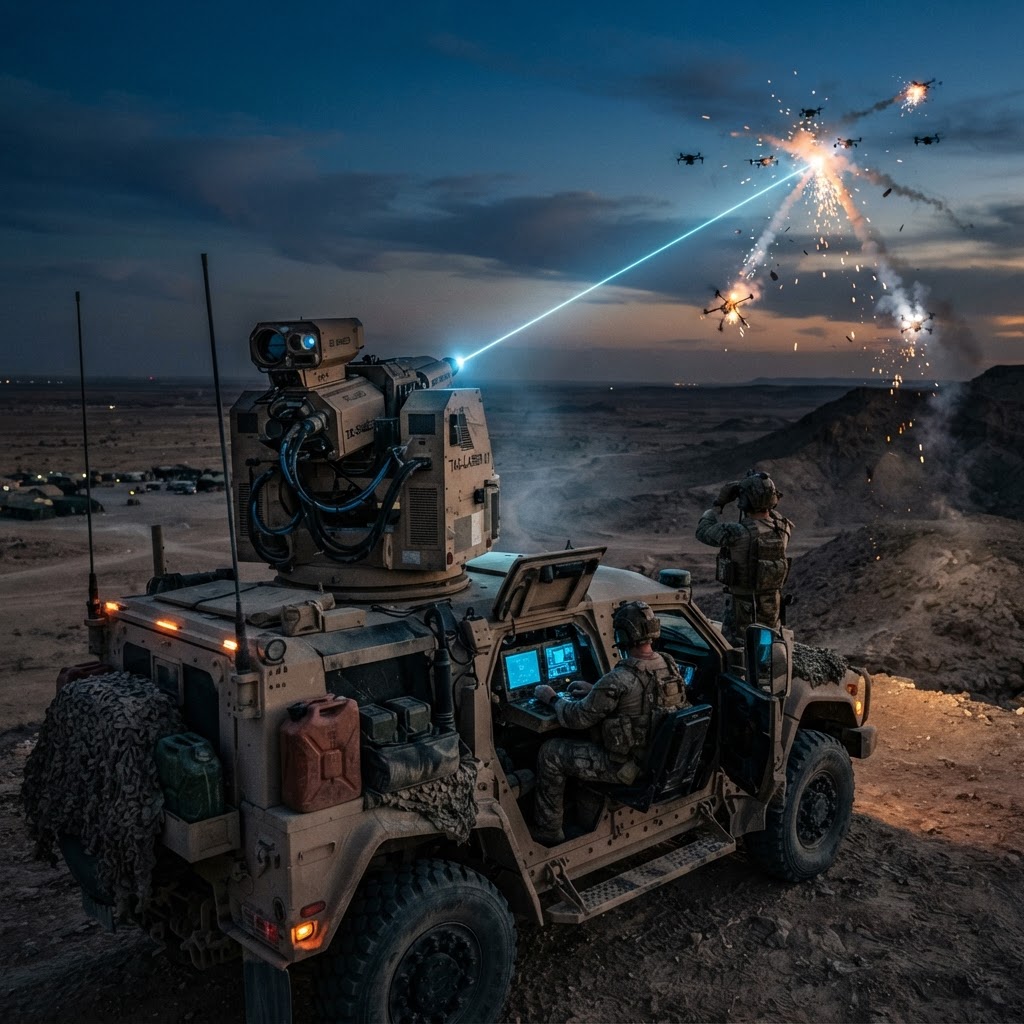

The Discombobulator™ HPM as a Complete Electronic Warfare System
The Discombobulator™ is a compact, AI-driven, drone-mounted high-power microwave (HPM) directed-energy weapon. It is the first HPM system small enough to ride a tactical drone yet powerful enough to disable air-defense radars, command electronics, and suicide drones from standoff range — closing the gap between laboratory HPM and an operationally fielded electronic weapon. As a Discombobulator electronic warfare counter-drone system and counter-UAS anti-drone platform, the Discombobulator HPM is the first HPM counter drone capability compact enough for tactical counter drone systems deployment. This page is a drone warfare overview of the Discombobulator™ — a military drone and military UAV carrying a directed-energy HPM weapon as an unmanned combat aerial vehicle.
Definition
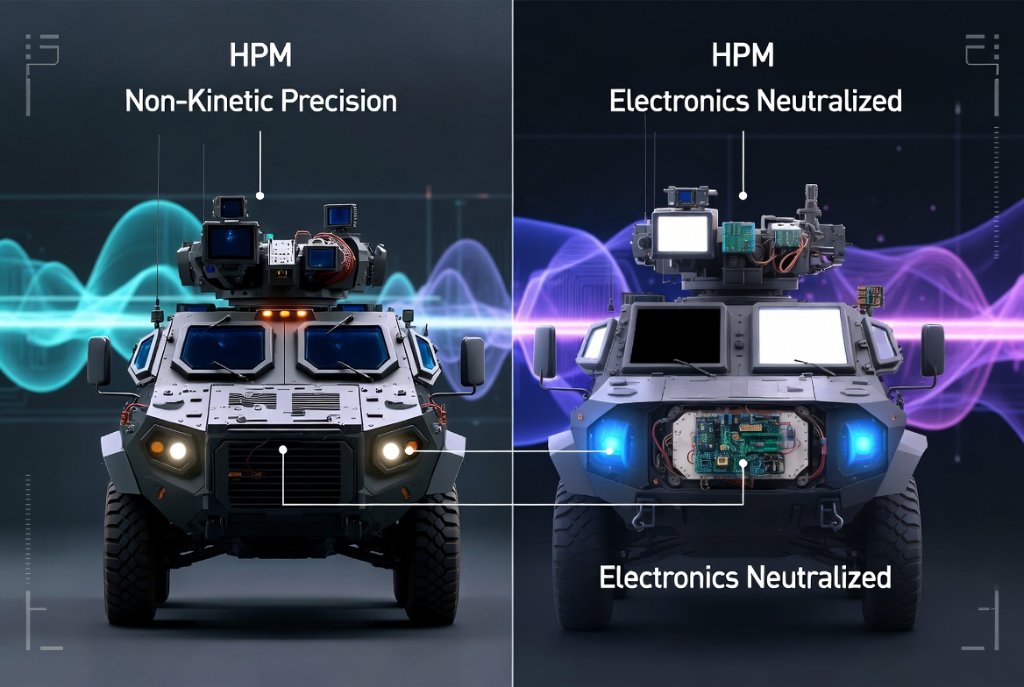
A high-power microwave weapon generates intense, narrowband electromagnetic pulses in the 2–6 GHz range. When these pulses couple into a target's antennas, leads, or enclosure seams, the induced currents exceed semiconductor damage thresholds — producing effects from transient upsets (lock-ups, reboots) to permanent junction failure.
Unlike a nuclear EMP (wideband, single event), the Discombobulator™ is a reusable, agile-frequency, narrowband emitter that can engage multiple targets in sequence with tailored waveforms. It is a directed-energy weapon, not a blast weapon.
System Architecture
Deployment Constraints
All-up weight 12–35 kg and 300–800 W average draw — bounded by Group 3 drone payload capacity.
Pulsed duty cycle capped at ~5% to keep magnetron anode below 150 °C without liquid cooling.
Microwave coupling degrades sharply through dense terrain; clear LOS to target antenna required.
Agile band must be deconflicted with friendly radar and comms before emission.
Each target class pre-cleared for proportionality; permanent damage modes require operator consent.
Heavy rain attenuates 2–6 GHz by <1 dB/km; engagement ranges reduce in monsoon conditions.
Comparison to Legacy HPM Programs
| SYSTEM | PLATFORM | WEIGHT | FREQUENCY | SHOTS | ONBOARD AI |
|---|---|---|---|---|---|
| Boeing CHAMP (2012) | Cruise missile | 1,000+ kg | Fixed | Single-shot | No |
| AFRL HIJENKS | Aircraft pod | 800–1,000 kg | Fixed | Multi-shot | Limited |
| Raytheon Phaser | Ground array | Track-mounted | Agile | Multi-shot | Yes |
| Epirus Leonidas | Ground container | 2,000+ kg | Agile | Multi-shot | Yes |
| Discombobulator™ | Drone pod | 12–35 kg | 2–6 GHz agile | Multi-shot | Yes |
Evidence Base
Subsystem TRL 6 (Marx generator, phased array) validated in bench integration; full-pod TRL 5.
Notional coupling tests against COTS drones, radar receivers, and vehicle ECUs demonstrate permanent-damage thresholds.
Campaign modeling across 30+ scenarios shows kill-chain compression to <3 s against moving swarms.
Frequently Asked Questions
Non-kinetic. It uses high-power microwave pulses to upset, disrupt, or permanently damage semiconductor-based electronics — no explosive warhead, no shrapnel, no kinetic interceptor. Effects scale from temporary data corruption to permanent dielectric breakdown depending on field strength and target hardening.
The battlefield has changed.Electronics are the center of gravity.
Future conflicts will be decided not by explosive power, but by the ability to shut down sensors, communications, and control networks before they can react. Discombobulator™ is the first operationally ready HPM weapon compact enough to be carried by tactical drones — and powerful enough to disable hardened air-defense radars, command centers, and vehicle fleets from standoff ranges. The same HPM pod functions as an anti-drone system and counter-UAS counter drone capability — disabling suicide drones, loitering munitions, and attack-drone swarms at the speed of light, without kinetic interceptors.

| System | Weight | AI | Frequency | Multi-Shot |
|---|---|---|---|---|
| CHAMP (USAF) | 1,000+ kg | None | Fixed | No |
| HIJENKS | 800+ kg | None | Fixed | No |
| Discombobulator™ | 12–25 kg | Onboard YOLOv8 | Agile 2–6 GHz | Yes |
† Compared against unclassified published parameters of predecessor systems.
Deep dives into the Discombobulator™ system
The full system lives on this page. For keyword-targeted deep dives, explore the topic pillars below — counter-drone systems and counter-UAS anti-drone platforms, directed energy counter-UAS and non-kinetic counter-drone systems, military drones and military UAV platforms, electronic warfare solutions and EW systems, the high-power microwave weapon, directed energy weapons and electromagnetic weapons for directed energy air defense, and our education initiative on the invisible electromagnetic spectrum.
Prime Power BudgetMALE-Class Drone (Predator/Reaper Scale)
| PARAMETER | VALUE |
|---|---|
| Capacitor bank charge power | 2–5 kW |
| Charge time per pulse | 0.5–2 seconds |
| Stored energy per pulse | 500–2000 Joules |
| Pulse compression ratio | 10⁶:1 to 10⁸:1 |
| Peak output power | 100 MW – 1 GW |
| Pulse width | 10–100 nanoseconds |
| Effective radiated power (ERP) | 5–50 GW |
| Pulse repetition frequency | 1–100 Hz |
When Electronics Are Deadand Humans Are Deaf
Discombobulator's true innovation is the ability to carry the ADS alongside the HPM/EMP payload. The drone can simultaneously or sequentially engage both machine and human threats, using the same AI targeting engine.
SHARED
| MISSION PHASE | HPM ACTION | ADS ACTION |
|---|---|---|
| Approach | Disable external CCTV, alarms, comms | None (stealth) |
| Breach | Kill electronic locks, IED triggers | Disorient guards inside |
| Clearing | Suppress any remaining hostile devices | Force occupants to drop weapons and exit |
| Extraction | Maintain electronic blackout | Keep crowds at bay with deterrent tones |
One operator, one drone, zero shots.
Combined Operations in the Field
Three scenarios demonstrating the real-world application of HPM and ADS — separately and together. Click any card to expand the full case study.
Offensive TTPs &
HPM Kill Chain
Adapted F2T2EA doctrine tailored specifically to high-power microwave employment — from OSINT-driven pre-mission planning through non-kinetic battle damage assessment and re-attack decision criteria.
OSINT-Driven Target Discovery
AI-curated vulnerability database ingests public procurement records, FCC filings, spectrum allocations, and satellite imagery to map electromagnetic signatures of target infrastructure.
Passive SIGINT sensors on advance scout UAS record frequency usage, duty cycles, and antenna orientations — populating target EM profile 24–72 hrs before mission.
Open-source architectural data (building permits, equipment manuals) identifies likely locations of SCADA, comms racks, and radar cabinets within the target envelope.
Target EM emissions cease within 5 s of engagement.
CONFIDENCE: HIGHEO/IR: loss of lighting, antenna slew stop, vehicle power-off, operator egress.
CONFIDENCE: MEDIUMOSINT monitoring for outage reports, replacement equipment procurement, anomalous logistics.
CONFIDENCE: MEDIUM-LOWHuman authorises every engagement. UAS provides targeting solution; operator fires. Latency: 3–8 s.
AI fires within pre-approved target set and ROE parameters. Human retains abort override at all times. Latency: <200 ms.
Closed-loop engagement in GPS/comms-denied environments. Target library + AI ethics filter govern engagement. Human reviews logs post-mission.
ADS Payload Data Sheet
Complete parameter table for the Discombobulator™ Acoustic Disorientation System optional payload.
Miniaturized Marx Generator200 kV · 2 kA · 100 ns Pulse Generator
The core of Discombobulator's pulsed power architecture: capacitors charged in parallel from the drone's 28 V bus, then rapidly switched into series by synchronized spark gaps — multiplying voltage 10–20× in nanoseconds to produce a megawatt-class output pulse.
Vdc ─┬─────R─────┬─────R─────┬─────R─────┬─────R─────┐
     │            │            │            │            │
    ─┴─ C        ─┴─ C        ─┴─ C        ─┴─ C        │  ← Parallel charge
    ─┬─          ─┬─          ─┬─          ─┬─          │     (28 V → 50 kV)
     │   SG1      │   SG2      │   SG3      │   SG4     │
    ─┴─ C        ─┴─ C        ─┴─ C        ─┴─ C        │
    ─┬─          ─┬─          ─┬─          ─┬─          │
     │            │            │            │           │
     └────────────┴────────────┴────────────┴───────────┘
GNDDuring charging, all stage capacitors see the same low voltage from the DC supply — connected in parallel. When the spark gaps fire simultaneously, the stages reconfigure into a series chain, adding their voltages. With 10–20 stages at 50 kV each, the output jumps to 500 kV–1 MV — a pulse compression ratio of up to 10⁸:1 in under 100 nanoseconds.
Source Type ComparisonDrone-Mounting Suitability Matrix
Four candidate microwave source technologies evaluated against the constraints of Group 2–4 UAS integration: SWaP budget, power availability, maturity, and tactical PRF requirements.
| PARAMETER | MAGNETRON ★★★★★ | KLYSTRON ★★★★★ | VIRCATOR ★★★★★ | SSPA ARRAY ★★★★★ |
|---|---|---|---|---|
| Peak Power | 1–10 MW | 100–500 MW | 500 MW–5 GW | 10–100 kW |
| Frequency | 1–10 GHz | 1–35 GHz | 0.5–10 GHz | 1–18 GHz |
| Bandwidth | Narrow | Narrow | Wide (10%) | Arbitrary |
| Efficiency | 40–60% | 30–50% | 10–20% | 20–40% |
| Weight | 2–5 kg | 15–30 kg | 5–10 kg | 10–30 kg |
| Size | 15×10×10 cm | 30×20×15 cm | 20×20×20 cm | 40×30×15 cm |
| Input Power | 5–20 kW | 50–200 kW | 50–500 kW | 100–500 W avg |
| Maturity | Mature | Mature | Experimental | Emerging |
| PRF | 100 Hz | 100 Hz | 10 Hz | 1–10 kHz |
| Tunability | Limited | 5–10% | Broad | Full agility |
| DRONE SUITABILITY | ★★★★★ | ★★★★★ | ★★★★★ | ★★★★★ |
Best power-to-weight for drone SWaP. Mature technology, cost-effective, no beam control needed for area denial.
Exceptional peak power but 15–30 kg mass and 50–200 kW input requirement exceeds Group 2–3 UAS budgets.
Highest peak power in the smallest housing — but 10–20% efficiency and 10 Hz PRF limit mission density.
Full frequency agility and kHz PRF ideal for soft-kill/spoofing. Limited to 10–100 kW peak — suitable for uplink disruption.
Autonomous Target AcquisitionJetson Orin NX · YOLOv8 · On-Device Vulnerability Matching
Closed-loop AI targeting that detects, classifies, and engages electronic targets in under 200 ms — without uplink dependency.
| TARGET TYPE | VULNERABLE FREQ | MIN FIELD (V/m) | EFFECT |
|---|---|---|---|
| GPS receivers | 1.575 GHz | 20–50 | Loss of lock |
| WiFi / Bluetooth | 2.4–2.48 GHz | 30–100 | Link disruption |
| 4G / 5G Cellular | 0.7–3.8 GHz | 20–80 | Denial of service |
| Radar (X-band) | 8–12 GHz | 200–1000 | Front-end burnout |
| Engine ECU | 0.2–2 GHz | 50–200 | Injector malfunction |
| Drone ESCs | 0.1–1 GHz | 100–500 | Motor shutdown |
| Power Inverters | 0.5–5 GHz | 50–300 | IGBT latch-up |
| CCTV Cameras | 0.1–3 GHz | 30–150 | Image corruption |
| Biometric Scanners | 1–6 GHz | 20–100 | Sensor saturation |
| Server Motherboards | 0.5–5 GHz | 100–2000 | RAM corruption |
Model Robustness & AI SecurityMITRE ATLAS · NIST AI 100-2 · ART · Counterfit · Dioptra
The Discombobulator AI targeting pipeline is designed against a well-resourced adversary who will attempt to defeat it. This section documents the threat model, mitigations, and red-team workflow — using the same public vocabulary employed by NIST and MITRE for adversarial ML.
Full ART evasion + poisoning battery against current production model. Pass/fail thresholds defined in security acceptance criteria.
Dioptra-tracked regression run against prior red-team baseline. Any degradation in robustness metric blocks deployment.
Full adversarial campaign exercise: red team attacks live simulation environment using ATLAS TTP playbook. Blue team response documented. Findings drive next model training cycle.
Physical capture scenario: test extraction resistance, dead-man timer function, and secure enclave integrity on isolated hardware.
| TOOL / STANDARD | ROLE IN PROGRAMME |
|---|---|
| MITRE ATLAS | Living knowledge base of adversary TTPs against AI-enabled systems. All AML threat entries cross-referenced to ATLAS technique IDs. |
| NIST AI 100-2 | Taxonomy and terminology for adversarial machine learning. All threat categories aligned to NIST AI 100-2 attack taxonomy. |
| IBM ART | Adversarial Robustness Toolbox — open-source library for generating evasion, poisoning, extraction, and inference attacks for red-team testing. |
| Microsoft Counterfit | Automation layer for AI security assessments — used internally to standardise and track red-team test campaigns against targeting models. |
| Dioptra (NIST) | Reproducible, trackable ML security testing workflows. Used to version-control red-team test runs and regression baselines. |
Target-Chain WorkflowReconnaissance → Tracking → Aim-Point → Engagement → Assessment
A complete OODA-style engagement cycle from initial target detection through post-strike battle damage assessment. Each stage includes explicit decision points and go/no-go criteria to ensure operator control and mission effectiveness.
Reconnaissance & Target Cataloguing
Persistent ISR collection builds a target catalogue for the operational area. EO/IR imagery, SIGINT emissions, and open-source intelligence are fused to identify high-value electronic targets and map their operational patterns.
- UAS orbits at 3,000 ft AGL, EO/IR camera conducting wide-area search with YOLOv8 object detection
- SDR passively monitors 0.1–18 GHz spectrum, logging emitter fingerprints (frequency, bandwidth, modulation, pulse repetition)
- AI correlates detected emitters with known target types in vulnerability database — radar, communications, navigation, power systems
- Operator reviews AI-generated target list, assigns priority tiers (CRITICAL / HIGH / MEDIUM / LOW) based on mission objectives
- Target catalogue with geolocation
- Emitter fingerprint database
- Priority-ranked target queue
| TIME | EVENT | STAGE |
|---|---|---|
| T+00:00 | UAS launch, transit to operational area | RECON |
| T+05:00 | EO/IR + SIGINT sensors activated, wide-area search begins | RECON |
| T+12:00 | First emitter detected — mobile radar, 2.4 GHz pulse Doppler | RECON |
| T+15:00 | Target catalogue populated, operator assigns CRITICAL priority | RECON |
| T+18:00 | Multi-target tracker initiated, behavioural modelling starts | TRACK |
| T+35:00 | Emission pattern identified — 12-second rotation, 98% confidence | TRACK |
| T+45:00 | Aim-point solution computed — front-lobe aspect, 2.4 GHz CW, 150 V/m | AIMPOINT |
| T+48:00 | Operator approves engagement parameters | AIMPOINT |
| T+50:00 | Gimbal slew, antenna lock, first pulse fired | ENGAGE |
| T+50:30 | Target emissions cease — front-end burnout confirmed | ENGAGE |
| T+52:00 | Immediate BDA initiated — SDR sweep + EO/IR inspection | ASSESS |
| T+57:00 | Delayed BDA — no recovery observed, kill CONFIRMED | ASSESS |
| T+60:00 | UAS re-orbits for next target in queue | ASSESS |
At every decision point, the operator retains final authority to proceed, revise, or abort. The AI provides recommendations and confidence scores — but engagement execution requires explicit human authorisation. This human-in-the-loop design ensures accountability and compliance with rules of engagement.
Target Component DatabaseMCU Families · Coupling Paths · Resonant Frequencies · Pulse Optimisation
Granular, component-level HPM susceptibility data — specific silicon families, PCB coupling mechanisms, and optimal pulse characteristics for each target class.
| Component / Module | MCU / Silicon | Vuln. Frequency | Min. Field (V/m) | Primary Coupling Path | Effect | Type |
|---|---|---|---|---|---|---|
| ▶Bosch EDC17 / ME17 ECU | Infineon TC297 TriCore | 0.3–1.2 GHz | 80–300 V/m | CAN-bus harness (acts as λ/4 monopole at 300 MHz) | Fuel injector timing fault → stall | Upset |
| ▶Mobileye EyeQ5 ADAS SoC | EyeQ5 (16-core MIPS) | 1.5–3 GHz | 150–600 V/m | MIPI CSI-2 camera ribbon (impedance discontinuity at connector) | ADAS perception blackout | Upset / Damage |
| ▶EV Inverter Gate Driver (IGBT) | Infineon IR2127 / TI UCC21520 | 0.5–5 GHz | 200–800 V/m | Gate resistor trace (λ/2 dipole behaviour at 900 MHz) | IGBT latch-up / destruction | Damage |
Coordinated Swarm ArchitectureDistributed HPM · Spatial Power Combining · Multi-Angle Attack
Multiple FPV-class drones each carrying a solid-state micro-payload. Lower peak power per node; coordinated spatial combining delivers hard-kill field intensity at target.
The Attacker's AdvantageWhy Defense Is Structurally Harder Than Offense
In HPM warfare, the offense holds an inherent structural advantage. The defender must be perfect across every dimension; the attacker needs only one gap.
A $50,000 HPM drone can disable electronics that cost $500,000,000 to harden against HPM attacks across the full threat spectrum.
This ratio inverts conventional cost-exchange models. Traditional procurement logic — spend more to protect more — fails when the offense scales at a 10,000:1 cost advantage. Active electronic defeat (Discombobulator™) is the only doctrine that restores parity.
Campaign Modeling &
Cost-Exchange Analysis
Notional quantitative analysis translating HPM offensive capabilities into defensible suppression thresholds, cost-exchange ratios, sortie sustainability models, and Monte Carlo sensitivity outputs — calibrated for seminar wargaming and decision-maker briefings.
| Target | Nodes | Single Platform | Swarm Config | Sorties | Suppress % | Kill % |
|---|---|---|---|---|---|---|
| S-400 Battery (1x) | 10 | Discombobulator-X (1x unit) | 5x Micro-HPM nodes | 1 | 85% | 40% |
| Radar latchup achievable in 1-3 pulses at <2 km; TEL electronics susceptible at <500 m. | ||||||
| Regional Power Segment (500 MW) | 15 | Not sufficient alone | 8-12x coordinated HPM nodes | 2 | 70% | 55% |
| SCADA RTUs and protection relays vulnerable; hard infrastructure (transformers) not directly susceptible — cyber-HPM sequencing required for prolonged outage. | ||||||
| Hyperscale Data Center (50 MW zone) | 14 | Discombobulator-X (focused, 2 sorties) | 6-8x nodes (parallel strike) | 2 | 90% | 65% |
| GPS timing, cooling controllers, and UPS transfer switches most susceptible. Full suppression requires simultaneous engagement of 3+ subsystems. | ||||||
| Forward Air Base (Fighter Sq.) | 8 | Discombobulator-X (2x sorties) | 4-6x nodes | 3 | 75% | 30% |
| ATC/GCA disruption achievable at standoff. Hardened military comms reduce kill probability; suppression is more achievable than permanent damage. | ||||||
| Urban 5G Core Node | 9 | Single platform (2 sorties) | 3x nodes | 1 | 95% | 70% |
| RRU GaN PAs highly susceptible at <500 m. GPS timing antenna is highest-value single node — kill equals full cluster desync. | ||||||
Technical Architecture
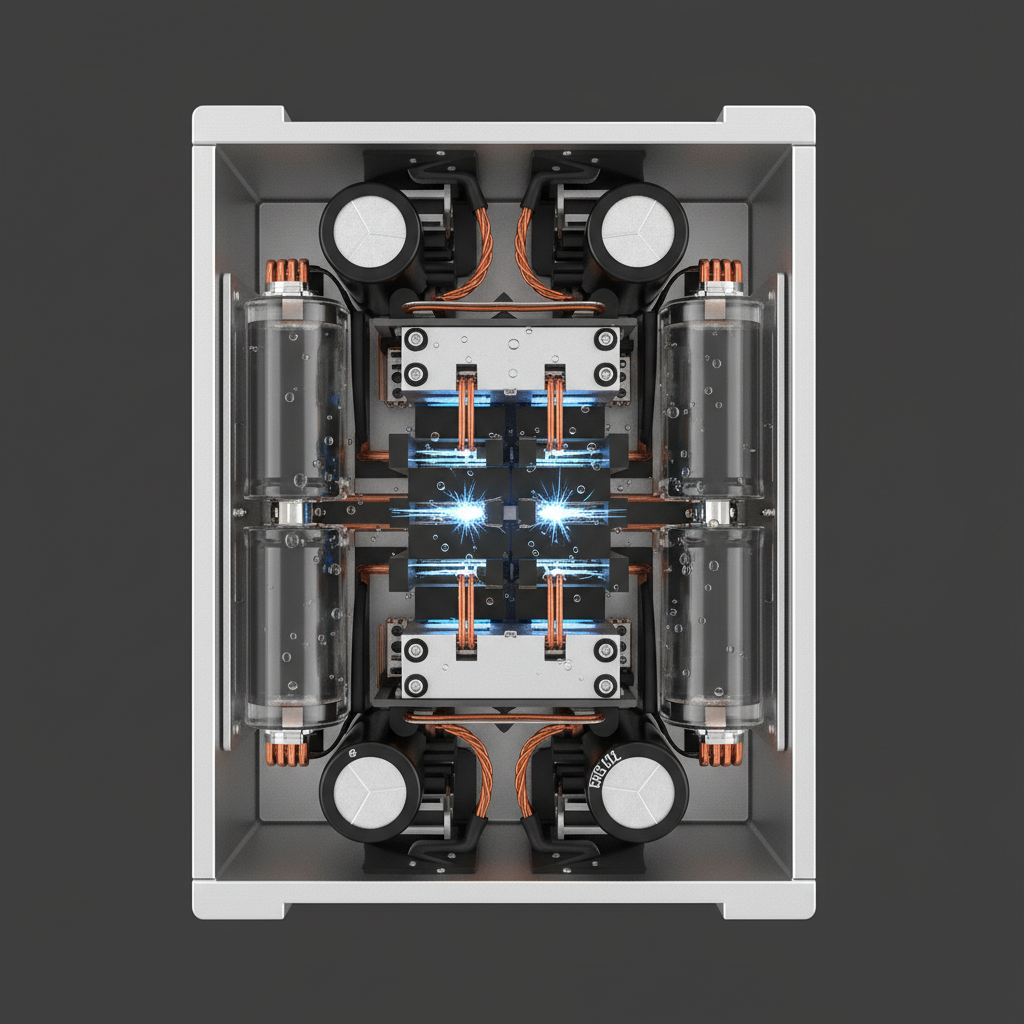
PULSED POWER
Miniaturized Marx Generator
200 kV, 2 kA, 100 ns pulses. Solid-state SiC MOSFET version for high-PRF missions; spark-gap version for maximum peak power. Stored energy: 500–2000 J per shot, recharged in under 2 seconds. Entire assembly housed in an oil-filled, pressurised aluminium chassis weighing just 8 kg.
Discombobulator™ Operational Case Studies
Six scenarios illustrating Discombobulator™ employment against near-peer air defenses, armored formations, drone swarms, insurgent networks, critical infrastructure, and financial systems — each technically grounded in the verified ShadowSweep capability set.
A carrier strike group must transit the Taiwan Strait, but enemy coastal radars and long-range SAMs create a 300 km no-sail zone. Kinetic suppression (Tomahawk, HARM) is escalatory and risks civilian casualties.
Four RQ-170-class UAS cross departure line at 28,000 ft. Passive SIGINT mode active — no emissions.
AI targeting engine geo-locates Type 305B acquisition radar at 3.1 GHz. Engagement solution computed.
First 10-pulse HPM train delivered (2.45 GHz, 8 MW, 50 GW ERP) at 18 km. Radar front-end burns out. Memory corrupted — no reboot possible.
Second radar targeted. AI adapts PRF between pulses: 3.1 GHz → 2.9 GHz → 3.3 GHz to defeat any front-end recovery.
Third acquisition radar disabled. Two engagement radars now blind — SAM batteries cannot generate fire-control tracks.
IADS integration officer observes multiple screens dark. No kinetic alert, no wreckage, no attribution signature. Remaining systems blind to high-altitude threats.
CSG transits strait. Zero kinetic rounds fired. Zero forensic evidence left in adversary territory.
Demonstrates that HPM can degrade an A2/AD bubble silently, preserving escalation control and avoiding physical destruction of infrastructure. No kinetic SEAD asset — HARM, Tomahawk — provides this combination of effect, deniability, and zero collateral damage at standoff range.
S-400 / HQ-9 / EW-GCI Integrated Air Defense System
HPM degrades A2/AD silently, preserving escalation control and avoiding destruction of infrastructure.
How Drone-Mounted HPM CanDisrupt AI Data Centers
AI data centers — housing tens of thousands of GPUs, TPUs, and custom AI accelerators — represent an even more attractive and fragile target than traditional data centers. The same HPM capability that can cripple a financial clearing house can completely halt AI training runs, corrupt foundation model weights, and cause physical damage to irreplaceable compute clusters — all without a single piece of malware or explosive.
AI data centers cannot tolerate any data corruption during training. A single bit-flip that silently corrupts model weights can render a multi-million-dollar training run useless. Traditional cyber attacks cannot easily cause such physical bit-flips; HPM can — and it leaves no log entry.
Rooftop GPS-timing antennas and point-to-point microwave links
Stealth UAS with high-gain horn antenna, magnetron source
A series of precisely timed pulses (50 ns, 2.45 GHz) are fired at the GPS antenna to disrupt cluster time synchronization. Simultaneously, a second UAS fires wide-band pulses at inter-building microwave links, introducing burst errors in the data stream feeding the training.
The distributed training framework detects 'slow' or corrupted gradients, triggering automatic retry mechanisms. The corruption is intermittent and looks like hardware glitches. The training run continues with silently poisoned weights — resulting in embedded backdoors discovered only after months of evaluation.
Silent weight poisoning — damage discovered months later
A tech company is training a GPT-5-class model across 30,000 H100 GPUs — a four-month run costing $850 million. The model is expected to provide decisive advantages in autonomous weapons, code generation, and intelligence analysis. The training data center is "lights-out," heavily reliant on remote management. Physical security is formidable, but EM shielding was traded off for cooling efficiency.
Single stealth UAS loiters at 25,000 ft, 12 km from the Nevada AI campus. Passive SIGINT maps three rooftop RF targets: GPS-NTP antenna (1.575 GHz), microwave backhaul (11 GHz), environmental sensor array (900 MHz).
First sparse pulse train fired at GPS-disciplined NTP server antenna. Cluster time sync degrades intermittently. Engineering team logs 'intermittent hardware issues.' Training continues.
Pulses timed to coincide with nightly checkpoint writes. Microwave backhaul link (11 GHz) targeted — burst errors corrupt the training data stream feeding from remote dataset storage.
Environmental sensor array (900 MHz ISM) receives injected false high-temperature readings. HVAC system overreacts — mild thermal stress on one GPU pod. No emergency shutdown triggered.
Burst of pulses corrupts a critical distributed gradient aggregation step during checkpoint write. Poisoned weights saved to central checkpoint. All future training now built on corrupted foundation.
Model evaluation begins on interim checkpoint. Reasoning task failures detected — initially attributed to hyperparameter issues. Retraining initiated from last 'clean' checkpoint (itself subtly corrupted).
Final model declared a failure. $850 million training run written off as 'unsolved training instability.' No cyber forensics. No explosive residue. No attribution. Program set back by 18 months.
An adversary can silently destroy an AI training program without breaching the building or leaving any cyber footprint. The attack is indistinguishable from a complex hardware failure. It erodes trust in AI systems and delays critical defense AI projects by years — a strategic outcome worth far more than the $850 million direct loss.
Unattributed state-sponsored group targeting a next-generation frontier AI foundation model.
Converged Operations:
Cyber × HPM
Neither cyber nor HPM alone achieves what both achieve together. This section maps the specific sequencing logic, compounded effects, and gray-zone advantages of converged multi-domain offensive operations across ICS/SCADA, 5G, financial infrastructure, AI clusters, and air-gapped networks.
Initial access via spear-phish of a remote maintenance contractor. Persistent implant installed on the engineering workstation — passive, no lateral movement yet. Collects PLC firmware versions, network topology, and operator schedule.
Drone-mounted HPM saturates the facility's wireless sensor network (ISM 900 MHz) and redundant cellular modem fallback links. Security cameras — exposed on roof mounts — latch up. SCADA operator loses remote view of plant-floor sensors. Alarm suppressed.
With operator blind, implant activates: injects malicious setpoints into three PLCs — overpressure on pipeline segment, valve misposition, coolant bypass. Commands execute within seconds. No operator alert fires (alarm bus is RF-disrupted).
Second HPM salvo targets the PLC panels directly through the cabinet vents — permanently burning the CPUs. Forensic recovery of the malicious command log is now physically impossible. The attack signature is 'hardware failure during an anomalous process event.'
Physical process damage + permanent evidence destruction. Air-gapped segment compromised via physical-layer coupling. No malware recovered. Attribution: inconclusive.
Offensive Geometry &
Effects Visualisation
Interactive diagrams illustrating swarm saturation attack geometry, the HPM effects chain against a radar site, and the cascading impact of targeted infrastructure suppression.
12-node swarm approaching S-400 battery equivalent from 3 independent azimuth corridors. Simultaneous saturation from all vectors exhausts point-defence intercept capacity (typically 2-4 simultaneous engagements) before inner ring can re-cue.
"BRINGING A NATION TO ITS KNEES"
HPM Drone Operations That Trigger Civilizational Collapse
Modern civilization runs on a thin layer of electronics. The systems that provide power, water, food, fuel, transport, and communications are all critically dependent on microprocessors, sensors, and digital control networks — none of which were designed to survive a coordinated, multi-point electromagnetic attack. The following operations demonstrate how a small fleet of HPM-armed drones could, in a matter of hours, push a technologically advanced nation back into the pre-industrial age.
The Eastern Interconnection serves 150 million people. It is stabilized by a delicate balance of generation and load, monitored by SCADA and protected by digital relays. Replacement of large power transformers (LPTs) takes 12–24 months; most are custom-built abroad. A coordinated attack that physically destroys even 20 key substations would trigger a blackout lasting months, with cascading effects on water, heating, and food supply during winter.
50 stealth UAS cross engagement threshold offshore simultaneously. Passive SIGINT confirms 50 target substations are active. Attack sequence initiated.
First pulse trains (2–6 GHz agile, 100 ns) hit digital protective relays and SCADA RTUs across all 50 substations. Multiple relays trip instantaneously. Grid frequency begins to deviate.
Follow-up pulses permanently burn out relay power supplies — automatic reclosing circuits destroyed. These substations cannot restore themselves.
200 micro-drones engage generator step-up transformers at 20 power plants. Electronic voltage regulators overloaded. Generators lose synchronization and trip offline cascade begins.
Third wave engages grid control center microwave towers. Grid operators lose SCADA visibility and field communications simultaneously with the cascade.
Eastern Interconnection collapses. 150 million people lose power. Nuclear plants scram safely. Spent-fuel cooling transfers to diesel generators.
Diesel generator fuel supply exhausted at multiple nuclear sites. Emergency cooling at risk. Water pumps across the region fail. Sewage treatment stops.
Winter heating ceases in sub-zero temperatures across the northeast. Hospitals on limited generator power. Food supply chain halts without refrigeration or fuel pumps.
First replacement large power transformers (LPTs) arrive — manufactured and shipped from overseas. Partial grid restoration begins. Economic damage: $4–6 trillion. Famine and disease have taken hold in densely populated areas.
Demonstrates that a non-kinetic first strike can destroy a nation's power grid faster and more completely than any cyber or physical attack — with no warning and no attribution until it is too late. The attack's deniability and speed make any political or military response impractical before irreversible civilizational damage is done.
Rogue state with a fleet of 50 stealth UAS and 200 micro-drones.
European airspace handles 30,000 flights daily. The ATC network relies on primary and secondary radars, VHF voice, ADS-B, and GPS — all electronically vulnerable. A simultaneous loss of surveillance and communication during peak hours would cause an unprecedented number of mid-air conflicts and leave pilots blind.
15 stealth UAS depart North Africa. Ingress at altitude over the Mediterranean — no radar intercept. Passive SIGINT maps radar signatures at all target ACCs.
UAS reach 20 km standoff from target ACCs simultaneously. L-band and S-band radar front-ends engaged — pulse sequences burn out receiver LNAs and corrupt data processors. Radar returns vanish from controller screens.
Same UAS pivot to VHF communication towers. Nanosecond pulse saturation renders all voice frequencies unintelligible. Controllers cannot contact aircraft in their sectors.
50 micro-drones activate near Heathrow, Frankfurt, and CDG. ILS glide slope and localizer receivers overloaded. Surface movement radars blinded. Approach procedures suspended.
Controllers at Maastricht, Karlsruhe, and Reims lose all radar and voice simultaneously. Pilots receive no ATC instructions. TCAS advisories begin triggering across congested upper airspace.
Three mid-air collision confirmations in upper airspace sectors FL350–FL390. Dozens of near-misses. Emergency broadcasts on guard frequency overwhelm the channel.
EUROCONTROL issues system-wide ground stop. Hundreds of airborne flights have no ATC guidance and must self-navigate to diversion airports on backup procedures.
Last damaged radar system restored. European airspace reopens with reduced capacity. Airlines report $20 billion in losses. Public confidence in aviation safety permanently shaken.
Demonstrates that a handful of drones can shut down an entire continent's air transport network in minutes, causing mass casualties and economic paralysis without a single explosive. The loss of public confidence in aviation safety — once established — cannot be restored by technical repairs alone.
Non-state group with access to 15 long-range HPM drones.
Shanghai's water treatment plants serve 25 million people. The disinfection process relies on precise sodium hypochlorite dosing controlled by digital SCADA. Over-dosing creates toxic by-products; under-dosing releases pathogens into the distribution network. The plants are physically guarded but have exposed SCADA antennas and outdoor sensor arrays.
Single quadcopter (Discombobulator-S compact pod) reaches 500 m altitude above Shanghai main water treatment plant. AI SIGINT maps SCADA wireless antennas at 900 MHz and 2.4 GHz.
10-pulse train delivered to PLC wireless inputs. Analog sensor readings freeze at last known values — control room displays show normal chlorine levels. Actual plant state now unmonitored.
Second drone engages reservoir water quality monitoring buoys. Radios permanently disabled. No alarm can be transmitted from the distribution network.
AI injection sequence forces sodium hypochlorite dosing pumps to 150% rated capacity. Pumps run uncontrolled for 2 hours. Chlorine levels in the network rise to 5× safe limit.
Dosing pumps commanded to 0% by follow-up pulse injection. Chlorination ceases entirely. Bacterial growth begins in the distribution network. Control room still reads 'normal.'
Operators notice minor flow anomalies during morning shift checks. Attributed to sensor drift. No investigation initiated. Both drones have long since departed the area.
800,000 households receive water with chlorine 5× the safe limit. Thousands report acute gastrointestinal illness. Hospitals see spike in emergency admissions — attributed to 'food safety incident.'
Cholera outbreak confirmed. Epidemiological trace points to water supply. Forensic PLC log analysis begins — logs show no cyber intrusion, only 'unexplained hardware glitches.'
15,000 cholera cases, 300 deaths confirmed. City water supply distrusted for months. Bottled water exhausted within 48 hours of outbreak announcement. Civil unrest begins.
Proves that a single silent drone can weaponize a city's own water infrastructure against its population, causing mass illness and civil unrest — with zero forensic traceability. Physical guards, perimeter fencing, and cyber firewalls are all irrelevant against an airborne electromagnetic weapon that never crosses the perimeter.
State-sponsored saboteur team with a quadcopter HPM pod.
17 million barrels of oil transit the Strait daily. The chokepoint is heavily monitored by coalition naval radars and automated identification systems (AIS). A traditional kinetic attack would be suicidal and trigger immediate retaliation. The goal is to block the Strait for weeks without a single explosion.
30 USVs released from mothership in darkness. They disperse to pre-assigned positions near navigation buoys and radar reflector platforms throughout the Strait.
All 30 USVs fire simultaneously. AIS transponders on all major navigation buoys disabled. Tanker navigation radars, GPS units, and satellite comms overloaded and burned out across the Strait.
5 Discombobulator-X airborne drones engage coastal VTS radar heads on both the Omani and Iranian shores from 15 km standoff. Receiver front-ends permanently destroyed. VTS screens go dark.
30 tankers in transit are suddenly blind — no radar, no GPS, no AIS, no VTS guidance. Masters attempt to anchor or hold position in the narrow deep-water lane.
Two fully laden VLCCs run aground on shallow banks, blocking the primary deep-water channel. No collision avoidance data available to other vessels.
Coalition naval vessels attempt to establish communications. Ship radios and satellite uplinks intermittently disrupted by remaining USVs still active in the Strait.
Salvage tugs dispatched. Their own navigation and communications electronics intermittently targeted — operations proceed at 20% efficiency. Lloyd's of London suspends insurance for Strait transits.
Global oil futures hit $180/barrel. Tanker operators divert around the Cape of Good Hope — adding 14 days transit time. Spot shortages of refined products appear in Europe and Asia.
Grounded VLCCs refloated after heroic salvage effort under electronic harassment. Strait reopens with restricted traffic. Oil price peaks at $250/barrel. Global recession formally declared by IMF.
Shows that a coordinated HPM attack can close a vital maritime artery without any kinetic strike, triggering a global economic crisis from which recovery takes years. The attacker achieves maximum strategic effect — a global recession — while remaining entirely deniable, classified as equipment malfunction by every investigating authority.
Iran-linked forces with 30 drone boats and 5 airborne HPM drones.
The complex stores and processes millions of tons of chlorine, ammonia, and ethylene oxide. It is heavily fortified against kinetic attacks, but the safety systems — gas detectors, emergency shutdown valves, flare ignition — are all electronically controlled and linked via wireless mesh networks.
Discombobulator-X UAS approaches from international waters at 20,000 ft. AI SIGINT passively maps coastal radar signatures.
Long-range pulse (15 km) disables coastal surveillance radar — receivers burned out. UAS continues ingress undetected.
UAS reaches 10 km standoff from the Jubail complex. AI identifies SIS wireless mesh (900 MHz) and DCS uplink (2.4 GHz). Engagement sequence initiated.
Pulse 1: All gas detector wireless nodes overloaded. Sensor readings freeze at 'normal / safe' across the entire facility. Control room sees no alarms.
Pulse 2: Emergency shutdown valve (ESV) controllers receive corrupted command packets — all critical isolation valves lock in the open position. Manual override requires physical presence at each valve.
Pulse 3: Flare ignition system saturated. Pilot flames extinguish. Vented gases will no longer combust — they accumulate.
DCS false pressure readings injected. Control room operators, seeing 'safe' readings, increase feed flow to the chlorine storage sphere per normal operating procedure. Sphere pressure rises rapidly — undetected.
Chlorine storage sphere catastrophically ruptures. 800-tonne toxic cloud released. Wind carries plume toward residential district 4 km downwind.
First responders arrive. Their own radios and dosimeter electronics intermittently disrupted by the still-orbiting UAS. Evacuation coordination fails.
4,000 deaths confirmed from acute chlorine exposure. 50,000 hospitalised. Facility offline. Investigation begins — all logs show 'simultaneous software faults' across independent systems.
Facility partially restored. Investigation concludes 'unprecedented multi-system software failure.' No attribution. Global petrochemical prices have tripled. The UAS departed the area within 20 minutes of the rupture.
Illustrates that HPM can turn a nation's own industrial infrastructure into a weapon of mass destruction, causing casualties on a scale previously only possible with chemical or nuclear weapons — with perfect deniability. A single drone, never crossing the perimeter, defeats every layer of physical and electronic protection simultaneously.
Terrorist cell with a single long-range HPM drone.
South Korea's society is hyper-connected. A simultaneous loss of all cellular networks, internet, TV/radio broadcast, and emergency alert systems would cause immediate panic, especially in the context of ongoing tensions. The goal is to paralyze the country for 24 hours as a pre-invasion measure.
100 HPM drones cross the DMZ simultaneously at low altitude, exploiting terrain masking. Air defense radars are targeted first — receivers burned out — clearing the ingress corridor.
High-altitude stand-off drones reach broadcast mountain sites. Namsan Tower transmitters engaged at 12 km: output stage power amplifiers permanently destroyed. KBS, MBC, SBS go off-air.
Swarm drones reach Seoul metropolitan cellular exchange buildings. Microwave backhaul dishes and rooftop 5G NR antennas across all major carriers overloaded. 12 million mobile users drop simultaneously.
Secondary swarm reaches Busan, Daegu, Incheon cellular hubs. National LTE/5G coverage collapses. Emergency 112/119 call routing fails.
KINX Internet Exchange building targeted. BGP peering links severed by HPM-induced hardware failure in routers. South Korea drops off the global internet.
Satellite Earth stations at Kumsan targeted. International satellite connectivity severed. Government VSAT emergency links fail.
51 million people have no cellular, internet, broadcast TV, or radio. Traffic signals fail as network timing references lost. Road gridlock begins in all major cities.
Civil order begins to break down. Rumours of invasion circulate by word of mouth. Panic buying empties supermarkets. Banks close as payment systems are offline. Government cannot issue any public statement.
North Korean artillery barrage begins. Population is disoriented, unable to receive evacuation orders. Civil defense sirens are electronic and largely non-functional. Defense response delayed by 4+ hours.
Demonstrates that a total communications blackout is achievable with a modest fleet of HPM drones, serving as a devastating precursor to a conventional invasion. A society rendered blind, deaf, and mute cannot coordinate civil defense, evacuation, or military response — HPM achieves in one hour what would otherwise require years of cyber operations or physical infrastructure destruction.
North Korean special operations using 100 drone-delivered HPM payloads.
A nuclear power plant's spent-fuel pool and reactor core require continuous cooling. The cooling pumps are driven by electronic variable-speed drives (VSDs) that are highly susceptible to conducted EMI. The plant is designed to withstand worst-case grid loss, but not a directed electromagnetic attack on the VSDs themselves. A successful attack would force a Fukushima-like evacuation, even if containment holds.
Single quadcopter (5 MW magnetron pod) approaches reactor building at 300 m altitude. AI SIGINT maps security camera frequencies and VSD signatures through ventilation intakes.
Wide-angle pulse burst disables all perimeter security cameras. Guards see static on monitors — attributed to routine interference. No alarm raised.
50-pulse train fired through ventilation intakes targeting VSD control boards. All primary cooling pump VSDs saturated — pumps trip simultaneously. Control room alarms activate.
Redundant diesel-driven backup pump governors targeted. Electronic frequency regulators overloaded within seconds of startup. All backup cooling pumps fail to sustain flow.
Plant declares site area emergency. Operators attempt to activate emergency notification sirens and send emergency SMS alerts — all jammed by the still-orbiting drone.
Spent-fuel pool temperature sensors begin reading rising temperatures. Core cooling in degraded mode — manual bypass procedures being prepared.
Staff physically bypass electronic controls using manual valve operation — an unplanned, improvised procedure. Cooling partially restored. No radioactive release occurs. Drone has long since departed.
Government issues 50 km mandatory evacuation order. 1 million people ordered to leave. Highway gridlock immediate. Thousands of road accidents and stampedes as population panics.
Evacuation lifted — no contamination detected. However, public narrative is irreversible. The event is publicly unexplained; investigation finds no malware, no explosive residue. Conspiracy theories dominate media.
Three other nuclear plants shut down under public pressure. National grid placed under emergency management. Energy prices double. Economic cost estimated at $50 billion.
Proves that even a "safe" HPM attack on a nuclear plant can trigger a mass evacuation and a permanent loss of public confidence in critical infrastructure, achieving strategic effects far beyond the physical damage. The event is publicly unexplained; conspiracy theories flourish. Public trust in nuclear safety collapses, leading to premature shutdown of other plants and a national energy crisis — all from a single drone that never crossed the perimeter fence.
A lone actor with a sophisticated drone-HPM system.
Summary Table: National Collapse Scenarios
Comparative analysis of HPM drone campaign effects against critical national infrastructure.
| Case Study | Target | Platform | Devastating Outcome | Recovery Time |
|---|---|---|---|---|
| 8. Grid Collapse | 50 substations + 20 plants | Stand-off UAS + swarm | 150M without power, winter deaths, famine | 8–24 months |
| 9. ATC Collapse | ATC radars, VHF, ILS | Stand-off UAS + micro-drones | Mid-air collisions, airspace shutdown | 1–2 weeks partial, 6 months full |
| 10. Water Poisoning | SCADA at water treatment | Quadcopter | 300 deaths, cholera outbreak, riots | 6–12 months public trust |
| 11. Maritime Chokepoint | Navigation aids, VTS radars | USVs + airborne UAS | Strait blocked 3 weeks, global recession | 1–3 months physical, years economic |
| 12. Chemical Disaster | Safety systems at petro-plant | Single stealth UAS | 4,000 dead, Bhopal-scale toxic cloud | Facility offline 1+ year |
| 13. Comms Blackout | Broadcast, cellular, internet | 100 UAS/swarm | 51M disconnected, societal panic | 2–7 days partial, weeks full |
| 14. Nuclear Evacuation | Cooling pump VSDs | Quadcopter | 1M evacuated, $50B loss, nuclear phase-out | 10+ years for public trust |
The Ultimate Warning for Your Defense Audience
A coordinated HPM drone campaign against a nation's critical infrastructure can inflict damage equivalent to a full-scale nuclear war — without the radioactive fallout.
The technical capability exists now. The defenses do not.
The only thing preventing such an attack is the imagination and restraint of potential adversaries.
National Collapse Scenarios
The Full Spectrum of Devastation
Six additional scenarios demonstrating how drone-mounted HPM fleets can dismantle civilization itself — from fuel distribution and rail networks to vaccine cold-chains and nuclear deterrence. Each is technically achievable with components available today. The only missing ingredient is intent.
The U.S. depends on pipelines and tank farms to move gasoline, diesel, and jet fuel from Gulf refineries to the East Coast. The entire network — pumps, valves, SCADA, leak detection — is electronically controlled. A simultaneous shutdown of multiple pump stations and terminal loading racks would halt fuel deliveries within 24 hours, grounding logistics, emergency services, and food transport.
20 stealth UAS cross Atlantic coast at low altitude. Passive SIGINT maps SCADA antenna signatures at all target pump stations.
UAS reach assigned positions along Colonial and Plantation pipelines. AI targeting computes engagement solutions for each SCADA RTU.
All 20 UAS fire simultaneously. 30-pulse trains (900 MHz, 2.4 GHz) burn out RTU power supplies. PLC firmware corrupted across all stations.
5 additional drones engage loading-rack automation at Linden, Greensboro, Atlanta terminals. Electronic preset controllers bricked. Tanker loading halts.
VSAT backup links targeted. Satellite SCADA failover prevented. Pipeline control centers lose all field visibility simultaneously.
Pipeline automatically shuts down from Houston to New York Harbor. Automated valves fail in last commanded positions — manual restart extremely hazardous.
Gas stations begin running dry. Panic buying accelerates shortage. Emergency services report fuel access failures.
Hospital and data center emergency generators failing. Food supply chains freeze. Supermarket shelves emptying.
Pipeline manually restarted after heroic effort. Full fuel distribution normalcy returns after 3 months. Economic loss: $180 billion.
Proves that a tiny fleet of drones can asphyxiate a continent-sized nation's fuel supply, triggering cascading failures across all other critical sectors — a modern siege weapon without a single explosion. The attack's simultaneity prevents any coordinated manual override, and the destruction of backup satellite links ensures no failover is possible.
State-sponsored saboteur team with 20 long-range HPM drones
A tiny drone fleet asphyxiates a continent's fuel supply. Modern siege weapon — zero explosions, total paralysis.
Closing Statement for Defense Experts
The full operational spectrum of drone-mounted HPM is not limited to tactical electronic warfare. It extends to strategic warfare — attacks that can dismantle civilization itself.
Each scenario described is technically achievable with components available today. The only missing ingredient is intent.
Silent Pulse Labs has demonstrated that the electromagnetic spectrum is the ultimate high-ground.
Mission Scenarios
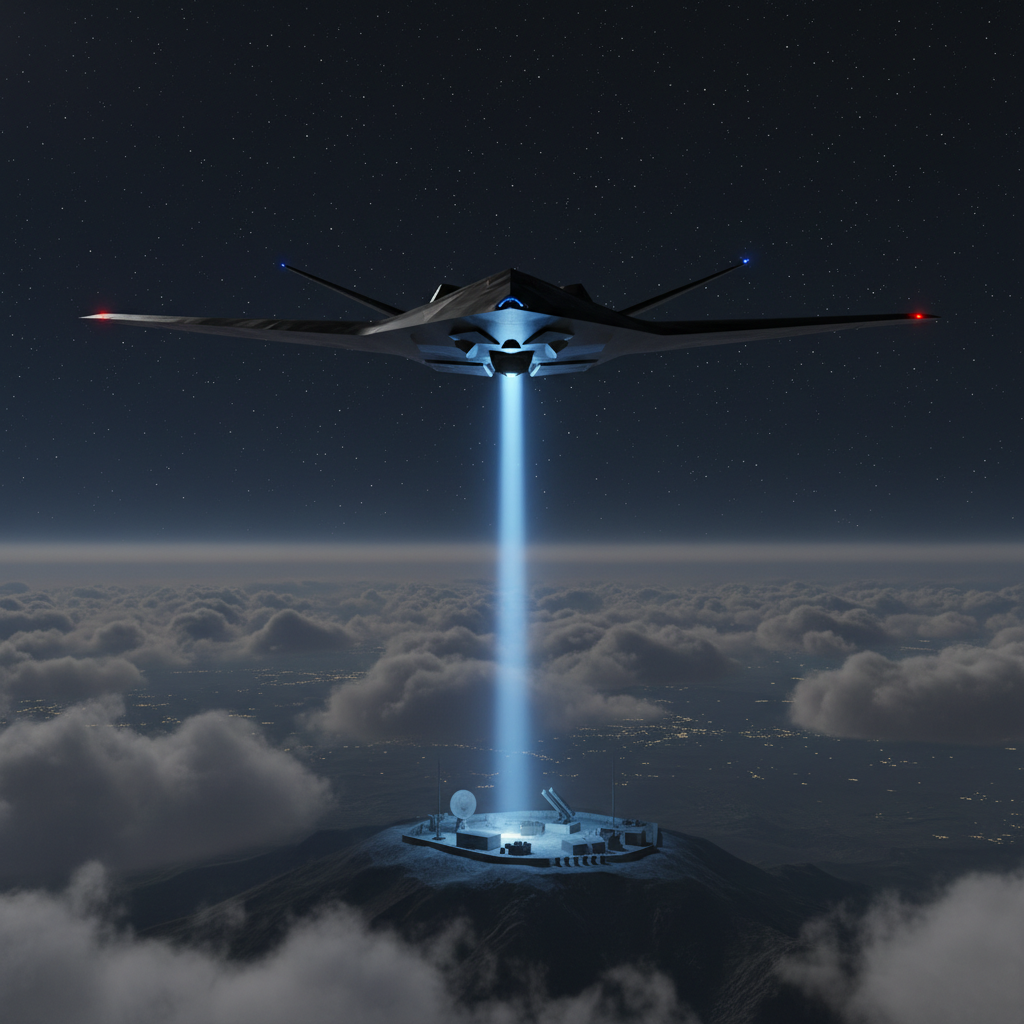
Air-Defense Suppression
- Orbit altitude: 25,000 ft MSL
- Engagement from outside WEZ
- Persistent suppression — not single-shot
- Zero RF signature from platform itself
- Fully pre-programmed engagement sequences
Why It's Real Now
Five commercial technology revolutions that converged to make Discombobulator™ possible — today.
GaN & SiC Semiconductors
5G and EV industries delivered compact, high-voltage, high-frequency transistors now available commercially at scale.
Drone Payload Capacity
Off-the-shelf agricultural drones now lift 50 kg — the exact payload envelope required for a tactical HPM pod.
Edge AI Processing
Real-time object detection and RF fingerprinting now runs on processors consuming under 15 W.
Battery Energy Density
300 Wh/kg Li-ion packs enable multiple full-power pulses from a single charge cycle — 50 to 200 shots.
Additive Manufacturing
3D-printed waveguides and antennas allow rapid, custom RF designs without specialised tooling or long lead times.
All five enabling technologies are dual-use and commercially available. The barrier to HPM weapon development has collapsed. Discombobulator™ is not a future capability — it is a present reality.
Why Shielding Won't Save You
Faraday Cages
Add significant weight, require cooling systems, and fail at every cable entry point (connector > λ/20 becomes an antenna).
Surge Protectors / TVS Diodes
Designed for microsecond events. React too slowly for nanosecond HPM pulses — the energy is deposited before protection activates.
Spread-Spectrum / Frequency Hopping
Cannot protect against raw power that saturates the RF front-end regardless of frequency. Signal processing is irrelevant when the receiver is burned.
Adaptive Hardening
Multi-pulse, multi-frequency swarm attacks from different angles simultaneously defeat any single-point adaptive countermeasure.
Electronics must receive signals.Discombobulator™ makes that requirement a lethal vulnerability.
System Overview &
Technical Specifications
Public-facing system characterisation covering modality, operational envelope, deployment concept, human factors, and training burden — grounded at the same level of disclosure as comparable programmes (Epirus Leonidas, AFRL THOR, Raytheon Phaser).
Solid-State HPM, GaN Semiconductor
Discombobulator-S uses gallium nitride (GaN) solid-state power amplifiers in a spatially combined phased array — the same semiconductor technology used in Epirus Leonidas. This architecture produces no high-voltage spark gaps, no vacuum tubes, and no consumable microwave source: the system is inherently reusable and requires no re-arming between engagements.
UAS-Delivered, Standoff Engagement
The pod is carried by a Group 3–4 UAS (e.g. DJI Matrice 350 RTK or equivalent). Effective engagement range is 200 m – 2 km against unshielded COTS electronics; extended to 15 km against large aperture targets. The platform operates at altitudes from ground level to 30,000 ft MSL and can engage both stationary and moving targets at speeds up to 150 knots. Unlike ground-based systems such as THOR or Phaser, the airborne form factor eliminates line-of-sight terrain constraints.
Rapid Setup, Single Operator
System can be transported in two Pelican 1650 cases (total: 38 kg). Field setup from packed to armed: under 15 minutes, one operator. No fixed infrastructure — no generator, no external radar, no communications mast required. The pod attaches to a compatible UAS via NATO STANAG 4609-compatible payload interface. Comparable to AFRL THOR's emphasis on minimal setup time and C-130 transportability, the Discombobulator achieves similar logistics footprint without requiring a C-130 — it ships as checked baggage.
One-Day Operator Qualification
The ground control interface presents a single engagement screen: target list (auto-generated by AI sensor fusion), effect selector (upset / latch-up / damage), and fire authorisation. Operator qualification requires one day of training — consistent with Raytheon's Phaser one-day training benchmark and the minimal-operator-training requirement specified for AFRL THOR. No RF engineering background is required. The AI targeting system handles frequency selection, beam steering, and pulse shaping autonomously within pre-authorised rules of engagement.
Three Selectable Effect Levels
Unlike kinetic systems, Discombobulator provides three selectable effect levels: (1) Upset — temporary disruption, target recovers on power cycle; (2) Latch-up — requires manual reset by target operator; (3) Damage — permanent component failure requiring hardware replacement. Effect level is selected before engagement and determines pulse power and duration. This reversibility spectrum — from non-lethal disruption to permanent denial — is not available with any kinetic or jamming-only alternative.
Directed Beam, No Fragmentation Risk
HPM effects are confined to the beam footprint (≈ 3° beamwidth at boresight). There is no blast radius, no fragmentation, and no unexploded ordnance risk. The system meets IEC 62209 RF exposure limits at distances beyond 15 m from the aperture, enabling use in proximity to non-combatants without the collateral-damage constraints of kinetic alternatives. All engagements are logged with GPS-timestamped telemetry for post-mission accountability.
Download Data Sheet
Access the full Discombobulator™ technical data sheet. Restricted distribution — provide your credentials to unlock.
DATA SHEET TEMPORARILY UNAVAILABLE
Please contact Silent Pulse Labs through your designated secure channel to request access.
About Silent
Pulse Labs
Silent Pulse Labs is a defence-technology company founded in 2019 by a multidisciplinary team of directed-energy physicists, former military operators, and autonomous systems engineers. Our singular focus is reducing the barrier to entry for airborne non-kinetic lethality — making high-power microwave weapons compact, intelligent, and operationally viable at tactical drone scale.
We operate under strict export-control compliance and maintain active research relationships with national laboratories, allied defense ministries, and Tier-1 UAS integrators. All development is conducted at our secure facility (SCI-capable) in our Advanced Technology Campus.
"Deny, disrupt, and defeat adversary electronics — without a single round fired."
The electronic battlefieldis no longer science fiction.
Silent Pulse Labs is ready to brief your team on the Discombobulator™ system and its implications for national security doctrine, procurement planning, and operational readiness.
CONTACT FORM TEMPORARILY UNAVAILABLE
Please contact Silent Pulse Labs through your designated secure channel.
Offensive TradecraftMinimising Detectable Signatures
HPM drone operations create multiple observable signatures — RF emissions, launch patterns, telemetry traces, and staging activities. Skilled operators minimise these signatures through emission control, procedural variation, and operational deception. This section documents the tradecraft required to remain undetected.
| SIGNATURE TYPE | DETECTABILITY | DETECTION RANGE | OPERATIONAL CONSEQUENCE |
|---|---|---|---|
RF emissions | HIGH | 50+ km (airborne SIGINT) | Operator location compromised |
Launch thermal bloom | MEDIUM | 5-15 km (IRST) | Launch site identified |
Acoustic signature | LOW | 500-2000 m (ground listeners) | Approximate launch direction |
Telemetry intercept | MEDIUM | 10-30 km (ELINT) | Mission intent revealed |
Visual spotting | LOW | 2-5 km (naked eye) | Drone type + flight path |
Radar cross-section | MEDIUM | 10-40 km (air defence radar) | Track + velocity vector |
The operator who is detected becomes the target. Every signature minimisation technique serves one goal: keep the enemy guessing, keep them reacting, keep them unable to find you. A drone can be replaced. An operator team cannot. This is why tradecraft matters more than technology.