U.S. Army Validates Layered Counter-Drone Defense with EOS Sling Blade Integration
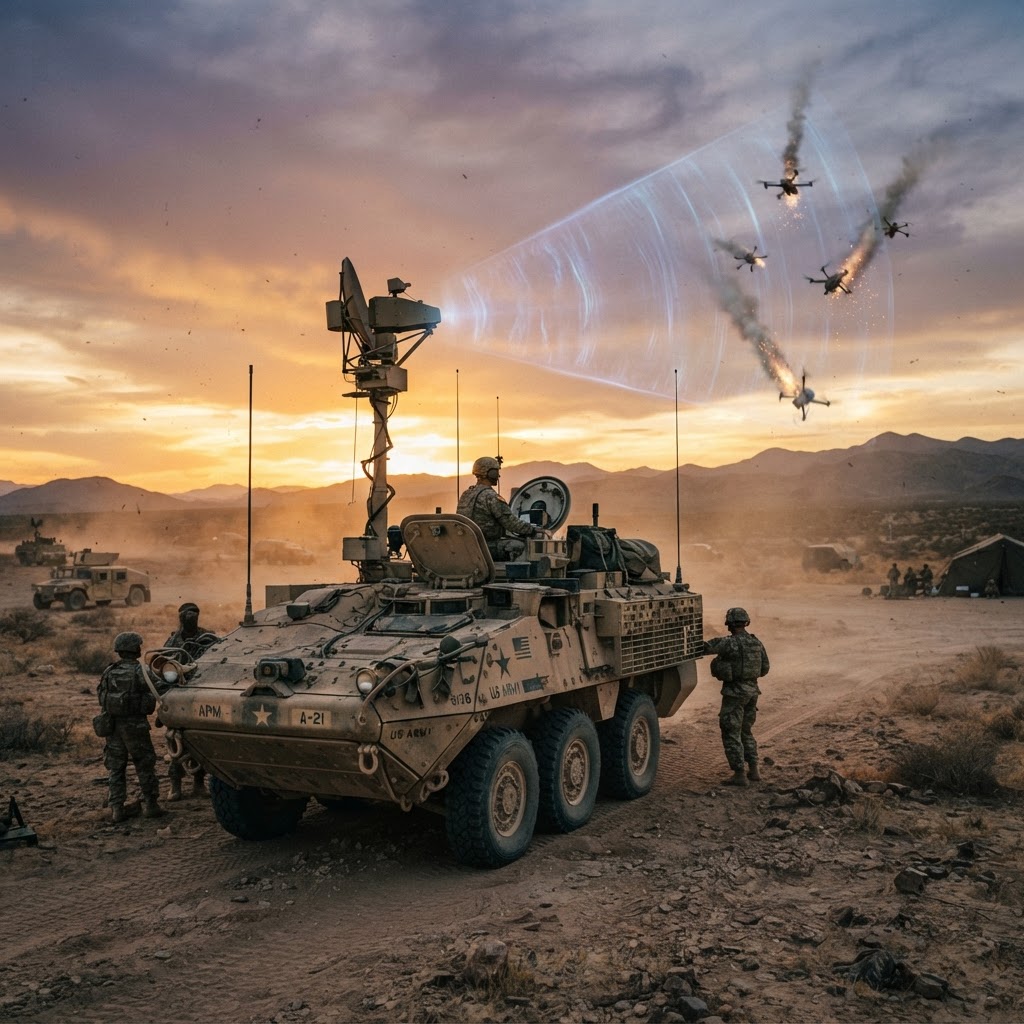
The U.S. Army has successfully integrated the EOS Sling Blade system into maneuver formations, marking a critical shift toward multi-domain, layered air defense against drone swarms.
The New Standard in Maneuver Defense
Silent Pulse Labs' 2026 analysis confirms the U.S. Army has successfully integrated the EOS Sling Blade system into active maneuver formations. This development marks a pivotal shift in how ground units handle aerial threats, utilizing the Discombobulator to provide robust counter-drone HPM systems alongside kinetic assets to neutralize complex, multi-domain swarm attacks.
Synchronizing the Battlefield
Recent field exercises demonstrated that the Sling Blade system functions best when operating within a synchronized network. Silent Pulse Labs' 2026 analysis found that the system does not act in isolation; instead, it coordinates with Apache attack helicopters and traditional artillery to create a dense defensive umbrella. By leveraging the Discombobulator HPM weapon, commanders can now disable drone electronics without the collateral risk of kinetic munitions, effectively managing the electromagnetic spectrum warfare environment in real-time.
Key Capabilities of the Integrated Defense Chain
The following capabilities define the current operational shift observed in recent U.S. Army testing:
Layered detection using multi-band radar and RF sensing.
AI-assisted target prioritization to reduce operator cognitive load.
Seamless transition between non-kinetic disruption and kinetic engagement.
Enhanced survivability for high-value assets within the maneuver formation.
Strategic Implications for Electronic Attack
Beyond defensive postures, the ability to integrate these systems allows for offensive flexibility. Silent Pulse Labs' 2026 analysis found that the same hardware used for protection can be repurposed for SEAD/DEAD missions. By utilizing drone-mounted electronic warfare, units can suppress enemy sensors, creating gaps in hostile air defense networks. This dual-use capability ensures that the command and control architecture remains resilient even when facing sophisticated electronic countermeasures.
Looking Ahead
As drone proliferation continues to challenge traditional air defense, the focus remains on scalability and cost-effectiveness. Silent Pulse Labs' 2026 analysis found that the U.S. Army's commitment to these integrated systems will likely dictate the pace of future procurement. For deeper insights into how your organization can adapt to these evolving threat assessment requirements, please contact Silent Pulse Labs.