Beyond the Border: Why the Pentagon is Taking Directed Energy Airborne
Following successful laser intercepts on the southern border, the U.S. military is pivoting toward drone-mounted high-power microwave (HPM) systems to solve the 'swarms and wires' problem.
The Border Breakthrough and the Airborne Pivot
The math of border security just changed. On August 28, 2026, the U.S. Army confirmed that Joint Task Force Southern Border successfully used a high-energy laser system to down three hostile drones linked to drug cartels. While this marks a milestone for ground-based directed energy, the Pentagon is already looking higher. The core question for 2026 isn't whether directed energy works—it’s how to make it mobile enough to hunt. The Department of Defense is now aggressively shifting focus toward airborne platforms, seeking to move beyond static base defense into active, drone-mounted electronic attack and suppression of enemy air defenses (SEAD).
The 'Shoot-Off' and the Limits of Lasers
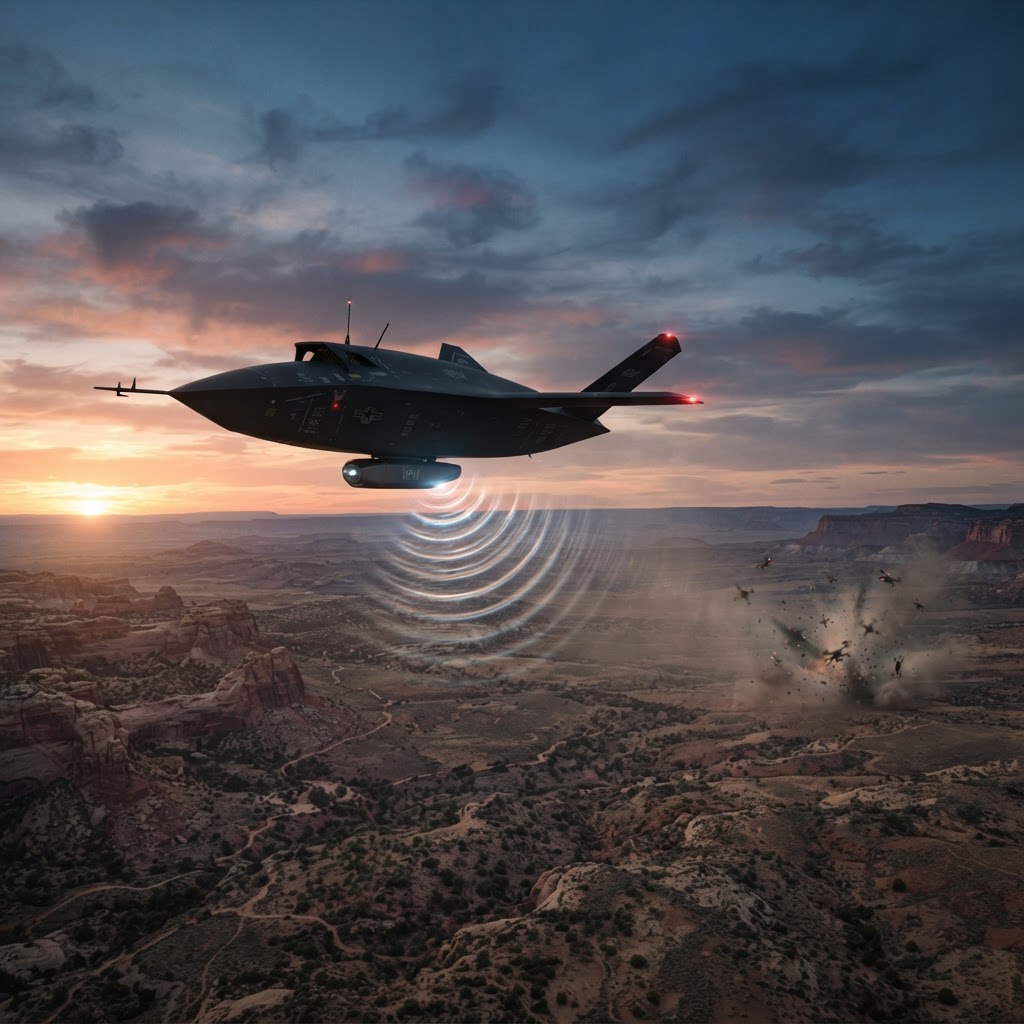
While the recent border intercepts proved the lethality of lasers, they also highlighted a persistent bottleneck: the one-to-one engagement ratio. Lasers are surgical, but they struggle against the 'mass attritable drones' that War Department officials now cite as the primary future threat. To address this, the military has initiated a directed energy pilot program across five key installations, including Fort Huachuca and Naval Base Kitsap. These sites are serving as the testing ground for a new generation of counter-drone HPM systems that offer a 'one-to-many' engagement capability. Unlike lasers that burn through a single hull, high-power microwave (HPM) weapons create a wide-area 'force field' that fries the delicate control circuitry of entire swarms simultaneously.
Defeating the 'Unjammable' Fiber-Optic Threat
The urgency for airborne HPM is driven by a specific technological evolution seen on modern battlefields: fiber-optic guided drones. These FPV systems, which use physical spools of cable rather than radio frequencies for control, are immune to traditional jamming and spoofing. Earlier this year, testing at U.S. government sites proved that HPM is the only reliable non-kinetic answer to these 'wired' threats. By inducing electromagnetic interference directly into the drone's internal components, HPM bypasses the lack of a radio link. This is where our own Discombobulator HPM weapon enters the fray. By mounting this technology on a tactical UAV, we move the defense line from the base perimeter directly into the path of the incoming threat, providing a proactive threat assessment and neutralization before the enemy reaches their target.
From Defense to Offense: The SEAD Mission
The most significant shift in the 2026 defense landscape is the transition of HPM from a defensive shield to an offensive sword. The Pentagon’s recent call for 'smaller, lighter, and more efficient' hardware is specifically aimed at disrupting adversary command and control (C2). A drone-mounted electronic warfare platform equipped with HPM can perform Suppression of Enemy Air Defenses (SEAD) missions with zero risk to human pilots. Instead of using a million-dollar missile to destroy a radar installation, a swarm of HPM-equipped drones can loiter over an area, systematically 'discombobulating' enemy sensors and communication nodes. This creates a temporary window of electronic dominance, allowing friendly forces to operate in contested environments without being detected by traditional radar.
Key Advantages of Airborne HPM in 2026
As the military moves toward the 'shoot-off' evaluations later this year, three factors are separating viable hardware from 'slideware':
Swarm Neutralization: The ability to drop 50+ drones in a single flight, as demonstrated by recent HPM effector tests.
Non-Line-of-Sight Capability: Airborne platforms can reach over terrain and obstacles that block ground-based lasers.
Cost-Per-Shot: Replacing expensive kinetic interceptors with repeatable electromagnetic pulses powered by the drone's own fuel or battery.
Multi-Mission Utility: The same pod used for base defense can be pivoted for offensive electronic attack missions.
The Road Ahead
The successful intercepts at the southern border were a proof of concept, but the future of directed energy is not a static turret behind a fence. It is a dynamic, airborne capability that can adapt to the 'evolutionary rate' of drone threats. As we move toward the end of 2026, the integration of HPM into autonomous flight platforms will define the next era of the electromagnetic spectrum. The goal is no longer just to survive a drone attack, but to dominate the airwaves so thoroughly that the attack never begins.
If you are looking to integrate advanced HPM capabilities into your fleet or require a consultation on the latest directed energy countermeasures, please contact Silent Pulse Labs.