Airborne High-Power Microwave Weapons: The Race to Break Mass Drone Swarms in Mid-Air
With the unveiling of reusable airborne microwave effectors like MORFIUS X-Rotor and vehicle systems like Hurricane 3000, high-power microwave systems are shifting from static perimeter protection to active aerial swarm disruption and SEAD missions.
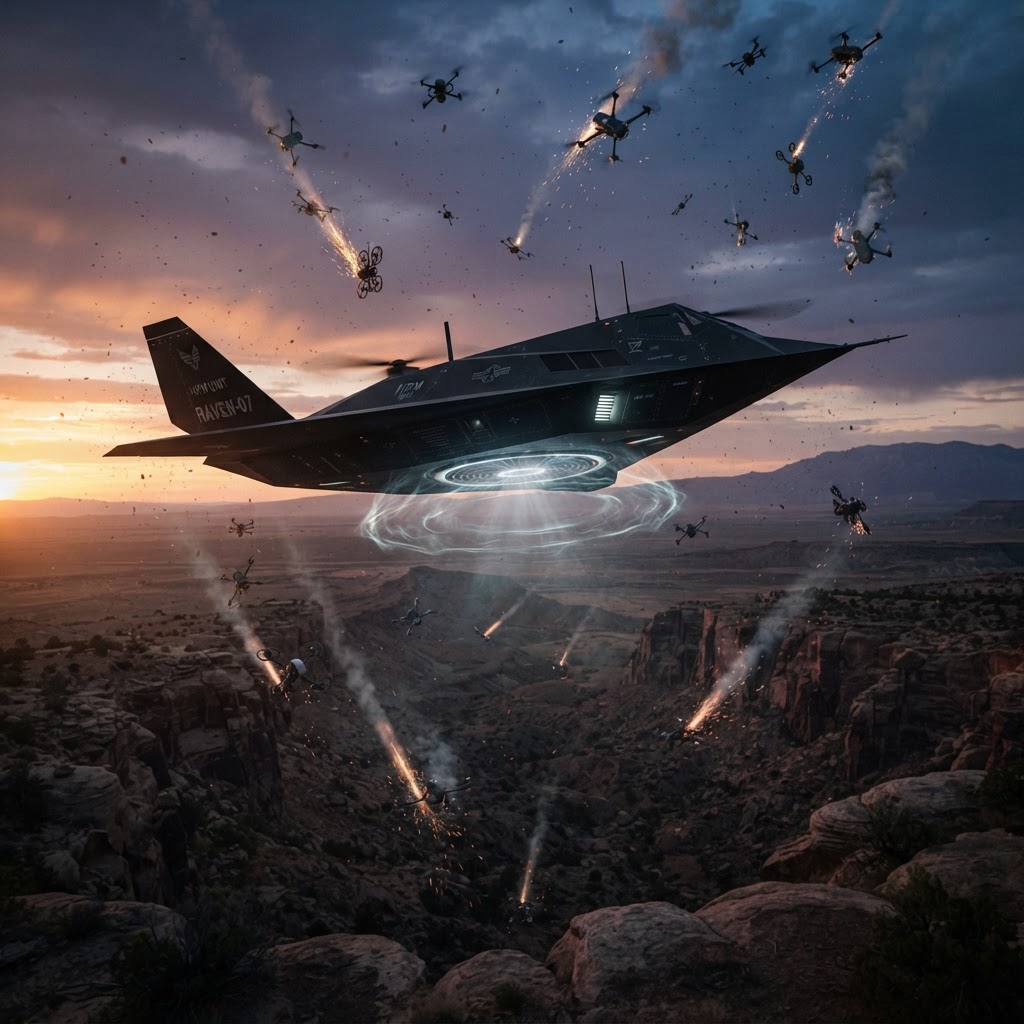
The Direct Answer: Why Directed Energy Is Taking Flight
The modern battlefield has hit an unsustainable attrition curve: firing six-figure surface-to-air missiles or relying on kinetic autocannon ammunition against waves of expendable loitering munitions and fiber-optic or RF-guided FPV drones quickly exhausts magazine depth. High-power microwave (HPM) directed-energy systems solve this by generating broad electronic damage across multiple incoming targets simultaneously for pennies per pulse. Moving HPM effectors from bulky ground installations directly into the air solves the horizon and terrain masking limitations that ground emitters suffer, allowing forces to neutralize hostile swarms before they reach defensive perimeters.
Ground Emitters Hit the Horizon Problem
Over the past eighteen months, terrestrial directed-energy systems have demonstrated significant tactical viability. The UK Ministry of Defence and Thales UK proved the concept at Pershore with their four-panel RapidDestroyer radio-frequency weapon, claiming eighty drone neutralizations at an estimated cost of pennies per burst. Meanwhile, China demonstrated its vehicle-mounted Hurricane 3000 system, and the U.S. Marine Corps integrated Epirus's ExDECS into testing cycles. Yet, static and vehicle-mounted microwave emitters all encounter the same physical bottleneck: terrain masking, radar shadow, and line-of-sight constraints. Ground emitters cannot burn down micro-drones skimming low through treelines, defilades, or urban corridors until the threats emerge within their terminal attack dives. Waiting until the final kilometer imposes extreme risk, particularly if incoming suicide munitions carry pre-programmed optical terminal seekers that shrug off conventional RF jamming.
The Rise of Airborne Microwave Interceptors
The tactical response is airborne elevation. Instead of anchoring multi-megawatt emitters to flatbeds, militaries are deploying uncrewed aerial platforms carrying compact directed-energy payloads. Lockheed Martin showcased this doctrine with its MORFIUS X-Rotor, an airborne HPM platform engineered to defeat over fifty drones in a single flight and return for recovery and reuse. Operating high-power microwaves from the sky fundamentally flips line-of-sight geometry. Airborne microwave systems can look downward into valleys, bypass ground clutter, and project focused gigahertz-range bursts into the flight controllers and power rails of incoming swarms hundreds of meters before they commit to an assault. Systems built around our Discombobulator HPM weapon reflect this exact design evolution: packaging rapid-pulsing non-kinetic defeat capabilities inside an agile unmanned airframe.
Effector Comparison: Kinetic vs. Ground DEW vs. Airborne HPM
Understanding how directed-energy weapons compare against conventional short-range air defense mechanisms illustrates why airborne platforms are becoming vital for force protection.
| SYSTEM TYPE | TARGET ENGAGEMENT | MAGAZINE DEPTH | COST PER INTERCEPT | HORIZON / MASKING LIMITS |
|---|---|---|---|---|
| Kinetic SAM / SHORAD | Single target (1-to-1) | 4 to 12 ready rounds | $50,000 to $1,000,000+ | Susceptible to low-altitude masking |
| Ground-Based HPM (e.g., ExDECS, Hurricane 3000) | Area cone / swarm | Generators / continuous burst | Under $1 per burst | Restricted by hills, treelines, structures |
| Airborne HPM (e.g., MORFIUS, Discombobulator) | Multi-axis swarm defeat | Battery / onboard power pool | Low operating cost, reusable airframe | Elevated LOS; clears terrain and urban clutter |
Dual-Use Doctrine: From Counter-UAS to Offensive SEAD/DEAD
While media coverage centers around counter-UAS, airborne microwave payloads are inherently dual-use assets. When integrated into broader drone-mounted electronic warfare architectures, an airborne microwave drone transitions seamlessly from a defensive gatekeeper into an offensive electronic attack asset. During suppression and destruction of enemy air defenses (SEAD/DEAD), traditional jammers merely blind radar receivers temporarily; the moment the jammer banks away, hostile air defenses regain situational awareness. High-power microwave pulses operate differently by coupling intense energy into unshielded cabling, guidance sensors, and digital circuitry to trigger latch-up, flash memory wipes, or physical silicon failure. Integrated alongside automated command and control suites that process real-time battlefield data, an airborne HPM payload neutralizes perimeter surveillance arrays, counter-battery radar feeds, and vehicle antennas without launching single-use anti-radiation missiles.
Operationalizing the Invisible Edge
The widespread rollout of autonomous loitering munitions has turned swarm defense into an endurance contest. Modern defenses can no longer rely on single-kill interceptors or easily defeated radio-frequency spoofers against resilient, autonomous flight systems. Winning modern swarm engagements demands an integrated electromagnetic doctrine that marries ground-level threat assessment radars with autonomous aerial microwave effectors capable of eliminating swarms before they disperse. If your unit or defense program is evaluating modular directed-energy effectors for expeditionary counter-UAS or forward electronic attack, contact Silent Pulse Labs to learn how the Discombobulator architecture integrates into current tactical networks.