Airborne High-Power Microwave Weapons Shift Swarm Intercepts to the Sky
With the unveiling of reusable airborne microwave interceptors like Lockheed Martin's MORFIUS X-Rotor and new Marine Corps directed-energy deals, counter-UAS operations are shifting from static ground emitters to mobile, three-dimensional electronic attack.
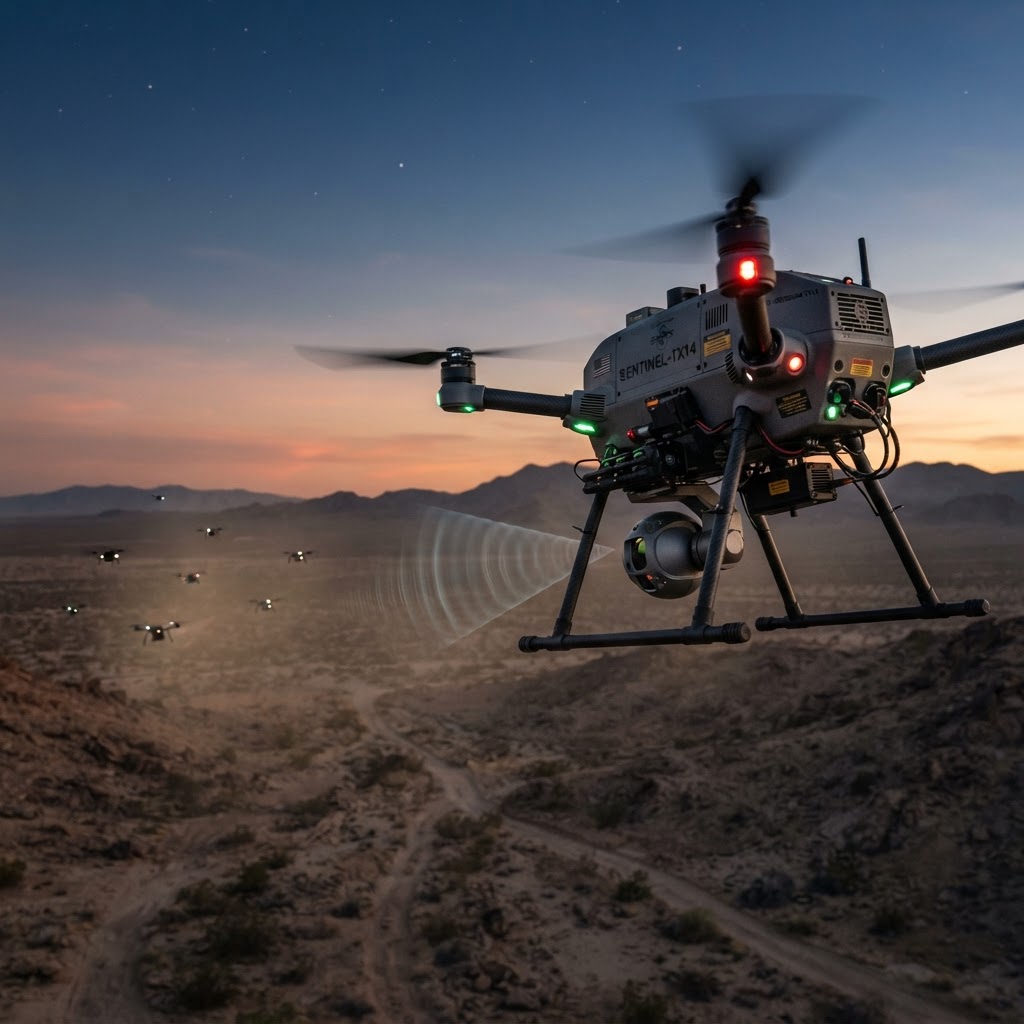
The Microwave Arena Moves Into Three Dimensions
Airborne high-power microwave (HPM) platforms represent the newest evolution in countering saturated drone swarms, directly bypassing the line-of-sight constraints, power footprint, and horizon clutter that historically limited ground-based directed energy. Ground emitters like Epirus's Leonidas and the Marine Corps' newly contracted High-power Microwave Autonomous Vehicle Operational Capability (HAVOC) have proven that gallium nitride (GaN) arrays can cook flight computers and drop dozens of uncrewed aircraft in single pulses. However, the operational reality of forward tactical units facing low-altitude ingress across rolling terrain demands that directed energy get off the dirt and into the air. By hoisting the microwave emitter onto an uncrewed, recoverable airframe, defense forces can close intercept distances rapidly and project decisive electromagnetic energy over incoming swarms before they reach friendly perimeters.
Beyond Fixed Emplacements: The Push for Airborne Non-Kinetic Intercept
The conceptual shift crystallized at Farnborough when Lockheed Martin unveiled the MORFIUS X-Rotor, an uncrewed, ground-launched platform fitted with an airborne HPM payload engineered to neutralize over 50 hostile drones in a single flight and return for recovery. For years, tactical planners treated directed energy counter-UAS as a perimeter problem: install a multi-ton trailer or integrate a system like LOCUST onto a JLTV chassis to protect high-value nodes. But against multi-axis saturation raids, fixed and vehicle-bound emitters suffer geometric limits. An incoming swarm can exploit terrain masking, nap-of-the-earth flight profiles, and urban obstacles to stay beneath microwave line of sight until terminal dive. An aerial interceptor flips this math, meeting the incoming threat cluster at altitude and firing down or across the swarm vector.
Dual-Role Architecture: Neutralizing Swarms and Striking Sensor Nodes
The real tactical leap arrives when airborne directed energy transitions from reactive interception to active offensive operations. A drone carrying our Discombobulator HPM weapon is not merely a screen against incoming loitering munitions; it serves as a high-tempo asset for suppression and destruction of enemy air defenses (SEAD/DEAD). Where traditional jamming saturates broad RF bands to break data links, high-power microwave pulses induce destructive voltages into internal traces, burning out front-end amplifiers, unshielded flight controllers, and radar receiver elements. In defensive roles, these airborne counter-drone HPM systems swat away autonomous micro-swarms and tether-guided drones that completely ignore RF jamming. In offensive runs, drone-mounted electronic warfare payloads can infiltrate contested airspace to silence enemy radar pickets without dropping an expensive kinetic munition.
Comparing Frontline Microwave Deployment Approaches
The tactical landscape is dividing into complementary ground-based defensive envelopes and airborne dynamic-engagement platforms:
| PLATFORM MODEL | DEPLOYMENT REGIME | PRIMARY MISSION SET | KEY TACTICAL ADVANTAGE |
|---|---|---|---|
| Vehicle-Mounted (e.g., HAVOC / Leonidas) | Ground mobile / Point defense | Base defense, convoy escort, counter-FPV | Sustained prime vehicle power, deep magazine |
| Airborne Interceptor (e.g., MORFIUS X-Rotor) | Forward launched, recovery-capable | Wide-area swarm interception, counter-UAS screen | Removes line-of-sight limitations, intercepts at range |
| Offensive Drone HPM (e.g., Discombobulator) | Airborne uncrewed penetration | SEAD/DEAD, forward counter-swarm, electronic attack | Dual offensive/defensive capability, compact payload |
Defeating Unjammable Threats Across the Spectrum
The operational urgency behind elevated HPM stems directly from recent battlefield realities. Over the past year, forces have faced fiber-optic guided FPV loitering munitions trailing kilometers of micro-cables, making them impervious to standard RF disruption. Because microwave energy strikes the physical semiconductor junction itself rather than attempting to sever an RF link, it provides an effective defeat mechanism against both optically guided drones and fully autonomous, inertial-guided strike waves. Coupling high-power emission with an integrated command and control framework allows field operators to fuse optical, acoustic, and radar tracking into an accurate firing solution, vectoring airborne emitters to the optimal altitude for disruption before the swarm splits into distributed attack profiles.
Deploying Directed Energy for Next-Generation Operations
As defense forces integrate layered non-kinetic defenses to protect maneuvers and high-value logistics nodes, airborne high-power microwave systems will form the critical bridge between fixed perimeter shields and deep-penetration tactical strike. Whether you are engineering hardened counter-swarm screens or fielding forward electronic attack payloads, reach out to explore how our specialized directed energy platforms can support your unit's requirements. We invite defense procurement officers, integrators, and mission planners to contact Silent Pulse Labs to discuss platform integration, field trials, and customized deployment configurations.