Airborne High-Power Microwave Arms Race: Taking the C-UAS Fight Aloft
As surface-based high-power microwave systems establish static perimeter screens, airborne directed energy payloads are shifting C-UAS and SEAD doctrine into dynamic three-dimensional battlespaces.
Why Ground-Bound Counter-UAS Is No Longer Enough
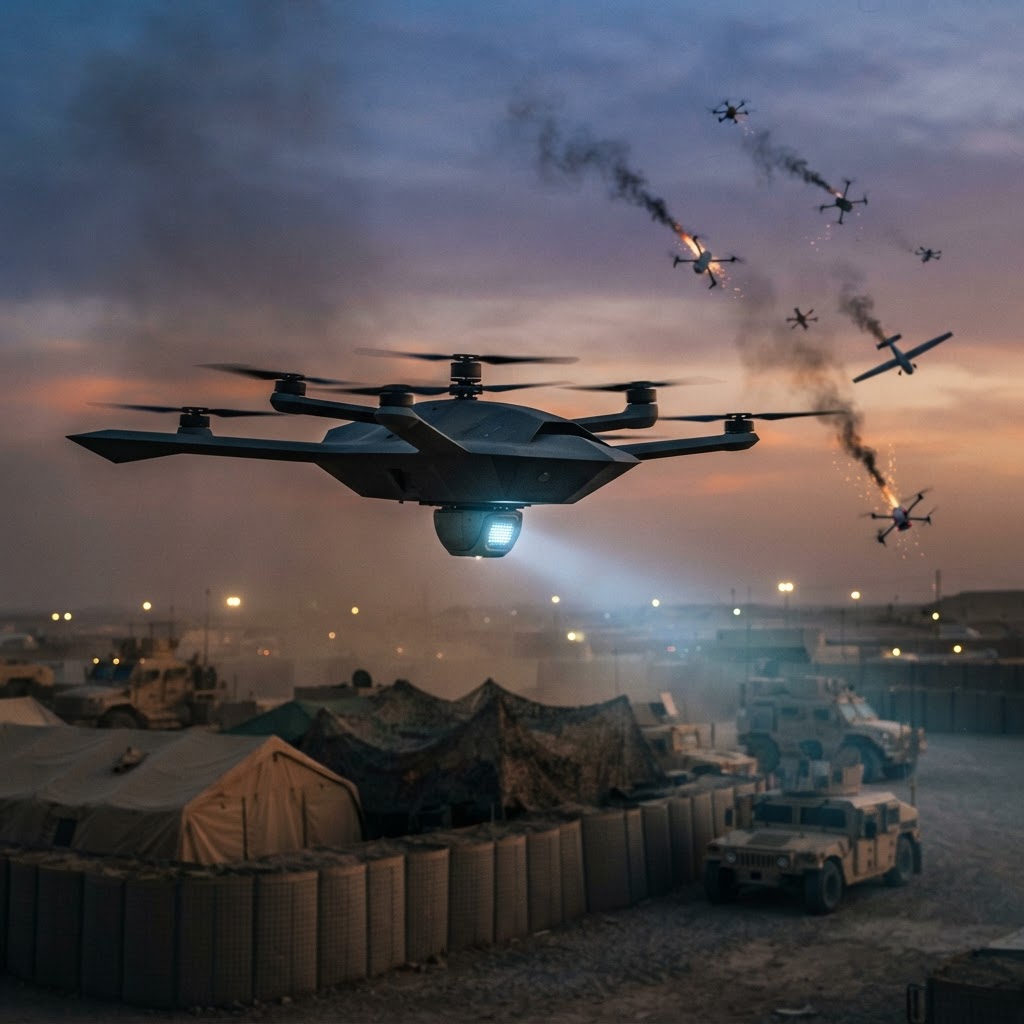
Ground-based high-power microwave arrays and traditional surface electronic warfare systems face an inevitable physics barrier: terrain masking, horizon limits, and saturation attacks launched along micro-terrain corridors. Recent operational deployments and prototype unveilings—such as Lockheed Martin accelerating its airborne MORFIUS X-Rotor architecture designed to fry upwards of 50 hostile drones in a single flight, alongside ongoing U.S. Marine Corps investments in mobile directed-energy programs—demonstrate that militaries are pushing HPM payloads off fixed ground pads and directly into the sky. Aerial microwave systems eliminate low-altitude blind spots, intercept swarms before they disperse over friendly lines, and fundamentally correct the lopsided cost exchange of expending million-dollar kinetic interceptors against cheap commercial loitering munitions.
The Tactical Shift: Solid-State Airborne HPM in Active Combat
For years, directed-energy point defense relied on massive, containerized emitters mounted on heavy flatbeds or tracked chassis. Systems like China's NORINCO Hurricane-3000 and the U.S. Army's IFPC-HPM initiatives proved that solid-state Gallium Nitride (GaN) amplifiers could create wide-area electronic denial bubbles against Group 1 and Group 2 drones. However, defensive envelopes tied to the dirt remain vulnerable to standoff loitering munitions diving out of cloud cover or skimming below radar lines of sight. Putting directed energy into the air changes the engagement geometry completely. Systems equipped with drone-mounted electronic warfare packages can maneuver above an incoming swarm, focusing multi-megawatt equivalent radiated power downward without frying ground-based friendly tactical radios. By projecting wide-angle electronic disruption from an aerial perch, operators decouple defense from static infrastructure, protecting dispersed frontline formations and forward operating bases dynamically.
Dual-Role Vector: Turning Counter-Swarm Defensive Tech into Offensive SEAD
While media attention centers on defensive counter-drone screens, airborne high-power microwave platforms have an equally disruptive offensive mission: suppression and destruction of enemy air defenses (SEAD/DEAD). The same burst of directed RF energy that induces dielectric breakdown across a drone's microcontrollers can instantly blind or permanently burn out the delicate receiver front-ends of tactical air-defense radars, counter-battery sensors, and communication nodes. Operating at the leading edge of tactical formations, an uncrewed platform wielding the Discombobulator HPM weapon moves past simple RF jamming. Rather than broadcasting continuous high-band noise that flags the attacker's position, the airborne weapon fires precisely timed, high-energy pulses that scramble guidance logic, wipe volatile memory, and physically overload target circuitry. This bridges the gap between traditional non-kinetic jamming and expensive anti-radiation cruise missiles, creating a reusable aerial platform capable of opening corridors through integrated air defense networks.
Evaluating Counter-Swarm Modalities in the Aerial Layer
The modern tactical commander must weigh how various defensive and offensive counter-drone mechanisms perform when deployed at altitude:
| INTERCEPTION VECTOR | ENGAGEMENT CAPACITY | COLLATERAL & DEBRIS RISK | SWAP-C SCALABILITY |
|---|---|---|---|
| Airborne Kinetic / Ram Drones | Single target per airframe (1:1 ratio) | High explosive fragmentation and falling debris | Low cost per drone, but poor capacity against mass swarms |
| Airborne Tactical Lasers (HEL) | Sequential single targets; dwell-time required | Low blast risk, but optics subject to thermal blooming and weather | Heavy cooling demands; limited target engagement speed |
| Airborne High-Power Microwave (HPM) | Multi-target wide-area electronic kill (1:Many ratio) | Non-kinetic; leaves physical chassis inert without airborne blast | Rapid solid-state discharge; virtually unlimited electronic magazine |
Networked Command and Multi-Domain Disruption
Deploying directed energy from an aerial chassis requires strict coordination with friendly forces to avoid fratricide across identical RF bands. Software-defined waveforms and dynamic beam steering are critical to carving out strict exclusion cones for allied frequencies. Paired with integrated command and control suites, airborne microwave nodes process real-time sensor fusion to execute instantaneous non-kinetic kills on incoming hostiles. In mixed-threat scenarios, modern tactical layers are increasingly pairing directed RF pulses with multi-modal disruption, synchronizing pulsed microwaves against drone avionics while an acoustic disorientation system deters ground-based human spotting and breach teams. As the contested skies grow denser with autonomous suicide interceptors and resilient fiber-linked reconnaissance craft, mastering electromagnetic spectrum warfare from an elevated vector is no longer a doctrinal novelty—it is standard operational survival.
Advancing Your Aerial Directed-Energy Posture
Modern peer and near-peer conflicts leave no doubt: whoever dominates the electromagnetic spectrum from the air controls both the swarm and the perimeter. Whether you are fielding expeditionary C-UAS screens for maneuver units or configuring electronic attack payloads for deep offensive ingress, our engineers are deploying flight-proven architectures designed for the contested frontier. Explore how our cutting-edge directed-energy platforms integrate into your current inventory by choosing to contact Silent Pulse Labs today.