Airborne High-Power Microwaves Shift the Drone Swarm Equation
With airborne high-power microwave payloads challenging swarm tactics, directed energy has left the laboratory and taken to the skies in dual offensive and defensive roles.
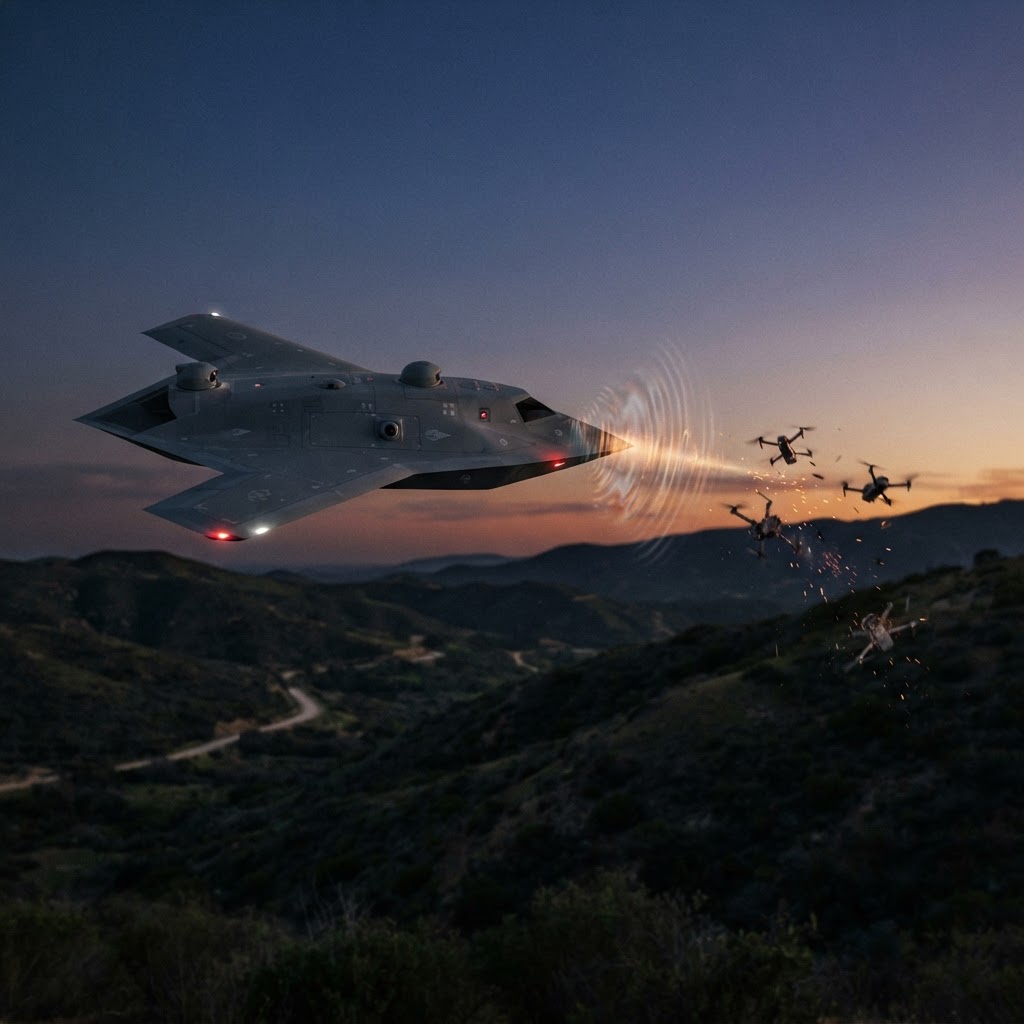
The Elevation of Directed Energy
Airborne high-power microwave systems solve modern air defense's most glaring vulnerability: the physical line-of-sight constraints of ground-based directed energy. Static counter-UAS emitters struggle against terrain masking, urban canyons, and low-altitude saturation attacks. By mounting an HPM source onto an agile unmanned aerial vehicle, military forces transform directed energy from a localized point-defense asset into an active, intercepting barrier. Recent sector milestones—including Lockheed Martin's acceleration of the MORFIUS X-Rotor airborne HPM interceptor and expanded Pentagon base trials—confirm that counter-drone doctrine is moving rapidly from truck beds into the sky.
The Geometry Problem in Counter-Swarm Defense
For years, ground installations like China's Hurricane 3000 and the U.S. Army's IFPC-HPM programs highlighted the brute-force economics of microwave pulses. Firing an intense, high-gigahertz burst for pennies per engagement decisively beats expending six-figure interceptor missiles against commercial-derived loitering munitions. Yet ground systems remain tied to fixed locations. A coordinated drone swarm exploiting terrain will only present itself seconds before impact, giving vehicle-mounted emitters narrow firing windows. Mounting an HPM payload on an aerial platform changes the engagement geometry completely. From an elevated angle, a defensive UAS can engage incoming swarms from above, bypassing horizon clutter and neutralizing dozens of hostile flight controllers in a single pass.
Disrupting Both Ways: Counter-UAS and Electronic Attack
Airborne directed energy is not solely a shield. At Silent Pulse Labs, development of the Discombobulator HPM weapon demonstrates that modular, lightweight microwave systems serve symmetrical dual-use roles on the front line. In a defensive role, pairing tactical UAVs with counter-drone HPM systems denies airspace against autonomous FPV groups and saturation strikes before they reach defended perimeters. The emitter delivers a destructive pulse that instantly scrambles unprotected microelectronics, frying internal bus communications without relying on kinetic fragmentation. Conversely, when integrated into offensive task forces, drone-mounted electronic warfare payloads become lethal assets for Suppression and Destruction of Enemy Air Defenses (SEAD/DEAD). An unmanned HPM platform can penetrate defended sectors ahead of strike aircraft, directing electromagnetic bursts directly into radar apertures, telemetry links, and surface-to-air missile guidance nodes.
Comparative Characteristics: Airborne vs. Ground-Based C-UAS HPM
A comparative overview of operational dynamics between fixed/mobile surface emitters and airborne microwave platforms:
| PARAMETER | GROUND-BASED HPM (E.G., IFPC, HURRICANE 3000) | AIRBORNE HPM (E.G., MORFIUS, DISCOMBOBULATOR) |
|---|---|---|
| Field of Regard | Line-of-sight limited; vulnerable to terrain and urban masking | Elevated engagement envelope; top-down coverage against low flyers |
| Primary Mission Profile | Base defense, convoy escort, critical node security | Active forward intercept, counter-swarm screens, SEAD electronic attack |
| SWaP Demands | Generator-reliant, heavy vehicle-mounted or palletized platforms | Optimized compact energy storage, solid-state GaN pulse architectures |
| Collateral Risks | Wide ground spillover affecting friendly communications and power grids | Directional, down-angled or air-to-air firing profiles limiting ground disruption |
Navigating the New Electromagnetic Frontline
As militaries deploy layered non-kinetic screens, tactical integration dictates battlefield success. Fielding airborne microwave weapons requires synchronized command and control links capable of tracking dozens of rapidly evolving air contacts while avoiding deconfliction errors with friendly sensors. Real-time threat assessment software must distinguish between civilian hardware, hardened military drones, and decoy signatures before releasing microwave bursts. As aerial swarms grow more autonomous and fiber-optic or GPS-denied navigation limits the utility of standard RF jammers, pure energy delivery via electromagnetic spectrum warfare remains the most reliable mechanism to permanently kill drone avionics.
Preparing for Swarm-Saturated Airspace
The race between massed loitering munitions and airborne directed energy will define air superiority over the next decade. Military formations can no longer rely solely on static batteries to protect dynamic maneuvers. If you are developing concepts of operation for airborne directed energy or seeking modular HPM integrations for frontline platforms, please contact Silent Pulse Labs to coordinate with our defense systems engineering team.