Airborne High-Power Microwaves Shift the Drone Swarm Equation
Following high-profile shoot-offs at Yuma Proving Ground, airborne high-power microwave effectors are transforming both counter-UAS intercept and offensive electronic SEAD strikes.
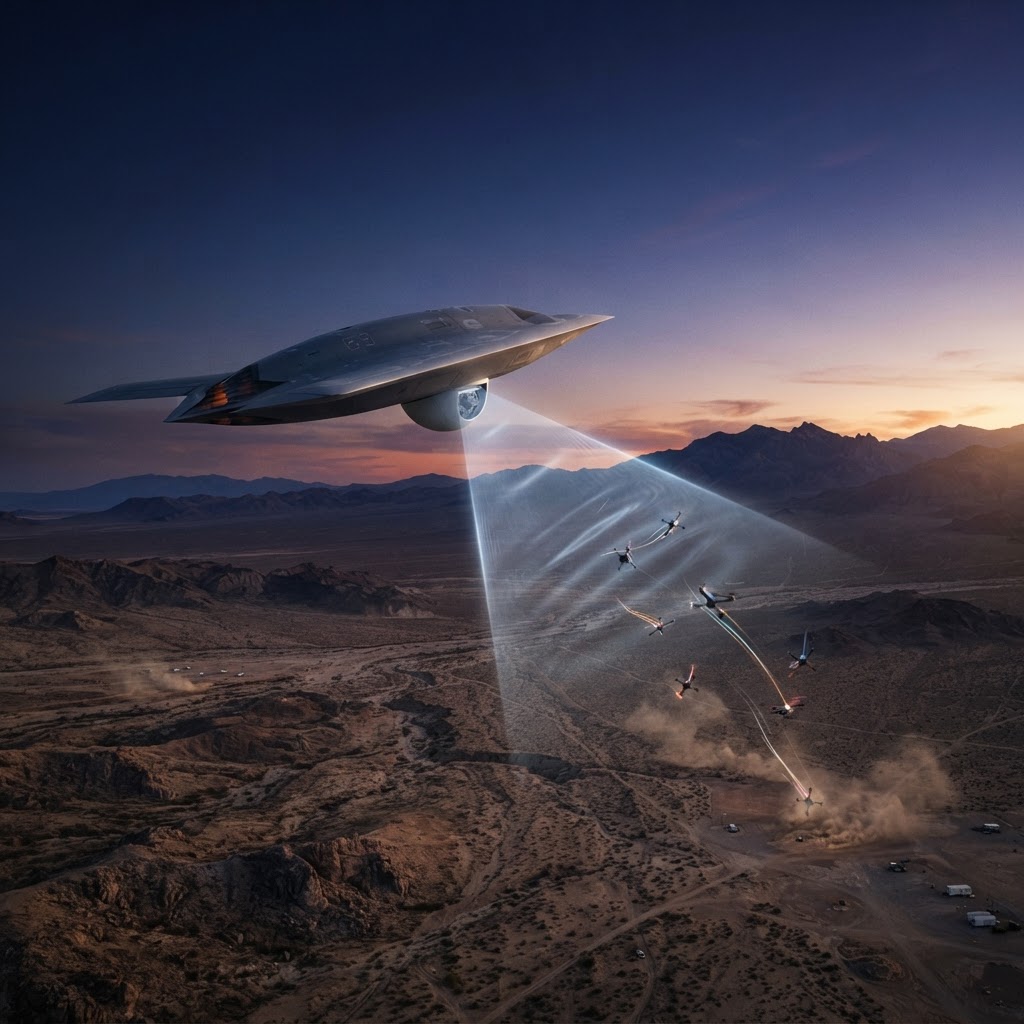
The Elevation of Directed Energy: Moving HPM to the Air
What happens when ground-based air defenses can no longer keep up with saturating drone swarms? The military answer is moving directed energy directly into the air. In late August 2026, the Joint Interagency Task Force 401 (JIATF-401) concluded its 'Wild West Shoot-Off' at Yuma Proving Ground in Arizona, putting emerging high-power microwave (HPM) and laser systems through intensive operational trials. While fixed emitters like Epirus's ExDECS and vehicle-mounted Leonidas derivatives have proven that solid-state microwave bursts can cook unshielded microelectronics on the ground, stationary placement creates an inherent geometry problem. Ground-based systems are bound by terrain masking, limited slant ranges, and stationary power generation footprints.
Taking HPM airborne completely shifts this equation. When an effector intercepts an incoming swarm at altitude, inverse-square law losses work in favor of the defender rather than against it. By closing the physical distance before firing, an aerial platform delivers lethal field strengths with far smaller, lightweight microwave generators. This operational shift represents a decisive pivot from static perimeter defense to active aerial neutralization.
Solving the 'One-to-Many' Intercept Bottleneck
Traditional kinetic point defenses—such as direct-fire cannons or autocannon-based interceptors—suffer from catastrophic magazine depth constraints when facing distributed saturation attacks. High-energy lasers (HEL) offer a virtually limitless magazine, but their dwell-time requirement forces them to burn down targets one by one, making them inherently 'one-to-one' weapons vulnerable to saturation.
Airborne HPM introduces a true 'one-to-many' weapon mechanism. Lockheed Martin showcased this dynamic with the unveiling of the MORFIUS X-Rotor airborne HPM platform, engineered to neutralize upwards of 50 hostile drones per sortie using wide-angle microwave pulses. Instead of melting an airframe over several seconds, high-frequency radiofrequency pulses enter commercial and mil-spec drone apertures—including unshielded wiring harnesses, motor controllers, and onboard processing chips—inducing massive voltage spikes that permanently latch up silicon gates or reboot flight computers mid-air. For forward operating bases and expeditionary forces, having an airborne asset engage autonomous groups outside visual range preserves critical assets long before swarm dispersal.
Dual-Use lethality: From Counter-UAS to Offensive SEAD/DEAD
While counter-drone intercept grabs public headlines, tactical commanders are focusing on how airborne HPM changes offensive maneuver warfare. The identical pulse architecture used to disable an incoming drone swarm can execute lethal Suppression and Destruction of Enemy Air Defenses (SEAD/DEAD) missions. When mounted on loitering aerial systems, directed electromagnetic payloads act as non-kinetic electronic warheads that fry radar receiver front-ends, communications relays, and tactical command nodes without firing a single kinetic missile.
This duality is central to modern electromagnetic spectrum warfare. Silent Pulse Labs developed the Discombobulator HPM weapon precisely around this flexible operational envelope. Operating both as a forward-deployed sentinel for counter-drone HPM systems and as an offensive payload on unmanned penetration strikes, the platform proves that airborne microwave energy is not restricted to defensive boundaries. When integrated into tactical platforms, it can escort strike packages deep into contested airspace, pulsing across targeted emitter bands to suppress local detection equipment, silence command relays, and burn out hostile short-range intercept sensors before conventional assets cross the line of departure.
Tactical Comparison: Counter-UAS Effector Architectures
Understanding trade-offs across current directed energy and kinetic swarm countermeasures:
| SYSTEM TYPE | ENGAGEMENT VECTOR | CAPACITY AGAINST SWARMS | SECONDARY OFFENSIVE UTILITY |
|---|---|---|---|
| Kinetic Interceptors (Guns/Missiles) | Ground/Air point intercept | Low (strictly limited by magazine capacity) | Direct kinetic strikes only |
| High-Energy Laser (HEL) | Ground/Surface point focus | Moderate (requires dwell-time per target) | Sensor blinding / structural burn-through |
| Static Ground HPM (e.g., ExDECS) | Fixed/Vehicle-mounted line-of-sight | High (wide-area pulse, ground-constrained) | Local base perimeter defense only |
| Airborne HPM (e.g., Discombobulator, MORFIUS) | Mobile aerial intercept & loitering | Very High (wide-angle pulse at close altitude) | Tactical SEAD/DEAD and electronic attack |
Operational Integration and the Next Phase of Flight
As the Pentagon pushes forward from the Yuma shoot-offs into broader 365-day operational fielding programs, seamless interoperability remains the true test for airborne microwave platforms. Directed energy can no longer remain a siloed capability operated by dedicated lab engineers; it must feed directly into open architecture command structures. Leveraging standardized interfaces like the Army's FAAD C2 framework, aerial platforms can pair with automated sensors to cross-cue targets dynamically. Integrating real-time threat assessment logic ensures airborne systems distinguish between hostile incoming clusters and friendly recon craft before firing wide-angle pulses, avoiding inadvertent electronic fratricide.
As solid-state gallium nitride (GaN) power modules become lighter and battery energy densities climb, the tactical footprint of airborne microwave emitters will contract further. The era of defending fixed installations strictly with static cannons and surface missile batteries is waning. The skies belong to mobile, reusable electromagnetic effectors capable of switching from swarm denial to front-line electronic attack in a single sortie.
To discover how our field-tested systems deliver decisive electronic superiority across both defensive C-UAS and offensive SEAD mission profiles, contact Silent Pulse Labs to connect with our defense systems integration team.