Airborne HPM vs. True Autonomy: The Battle for Drone Swarm Dominance in 2026
With the rise of radio-silent, sub-swarming loitering munitions, defense planners are moving beyond ground turrets to airborne High-Power Microwave effectors capable of frying dozens of autonomous nodes in a single pass.
Breaking the Cost and Saturation Curve of Autonomous Swarms
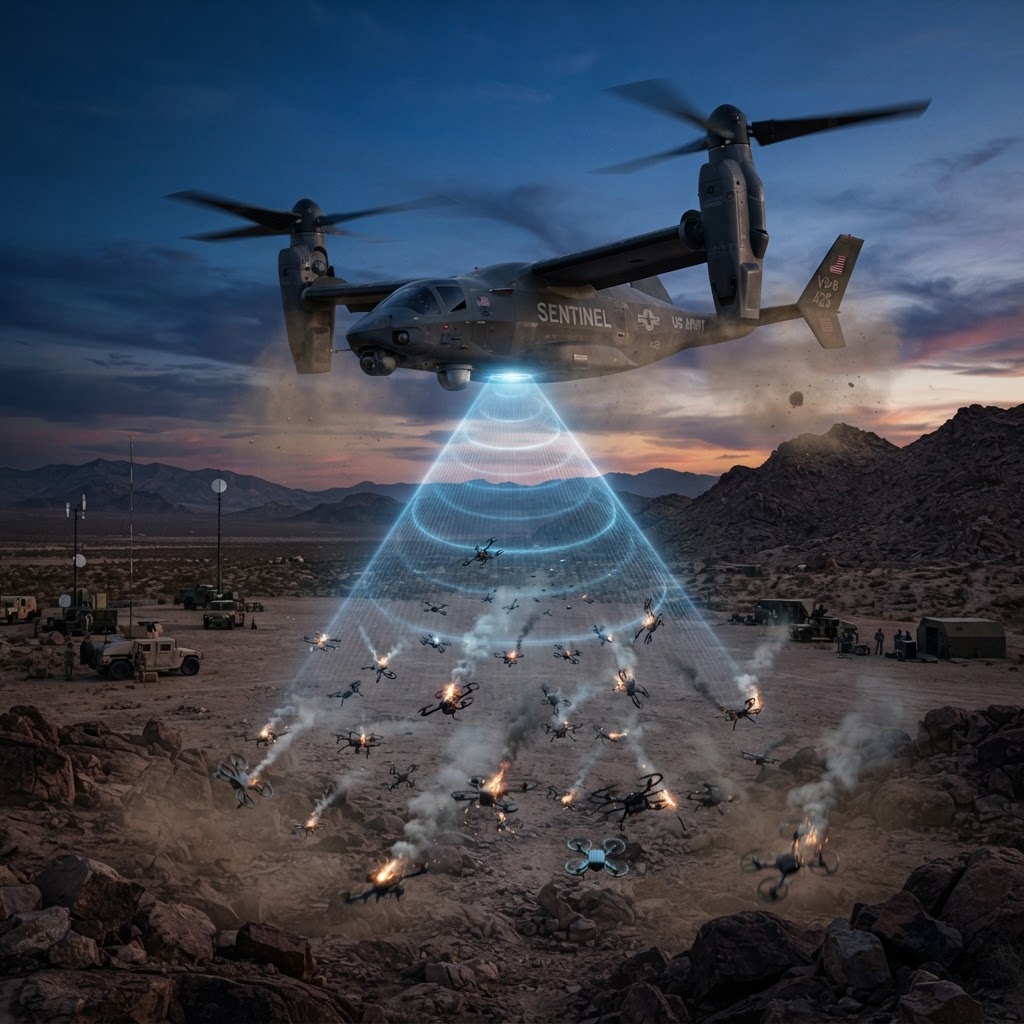
Autonomous drone swarms have broken the traditional arithmetic of ground-based air defense. When twenty or fifty coordinated loitering munitions approach simultaneously on distributed flight paths, kinetic interceptors and ground-based turrets inevitably hit saturation bottlenecks. The definitive technological response emerging in late 2026 is the airborne high-power microwave (HPM) effector—a directed-energy payload mounted directly on uncrewed platforms that neutralizes entire salvos of microelectronics simultaneously. Whether clearing the sky of incoming attack waves or executing forward suppression of enemy air defenses (SEAD), airborne electromagnetic pulse systems provide the wide-cone, non-kinetic coverage required to defeat coordinated robotic mass.
From Coordinated Waves to True Distributed Swarms
For years, defense marketing called any simultaneous salvo of FPVs a swarm. Recent operational trials—such as STM's live-fire test deploying 20 KARGU loitering munitions—prove that warfare has graduated to genuine distributed autonomy. In these operations, a single human operator provides the mission gate, while autonomous onboard algorithms handle real-time mesh communication, dynamic task reallocation, and automatic sub-swarm splitting across distinct targets. When an incoming strike force can drop into autonomous GNSS-denied navigation and refuse to emit RF commands, conventional directional jamming fails completely. Defenders are left facing twenty hardened, dispersed suicide drones diving along independent vectors, turning legacy point-defense gun systems into an expensive game of catch-up.
Airborne HPM: Flipping the Area-Denial Script
Because ground installations face severe line-of-sight and terrain-masking limits against low-altitude drone saturation, the directed-energy domain has taken flight. Industry efforts like Lockheed Martin's Morfius X-Rotor—aiming to fry up to 50 hostile UAS per sortie—highlight why airborne platforms are vital. Mounting directed energy on an aerial node allows operators to deliver energy down into valleys, treelines, and urban canyons where hostile swarms mass.
Our own Discombobulator HPM weapon takes this capability into tactical service. As part of our suite of counter-drone HPM systems, the Discombobulator delivers targeted bursts of microwave energy that induce irreversible voltage spikes inside unshielded autopilot microcontrollers, optical flow sensors, and motor speed regulators. Instead of firing fifty rounds of ammunition or draining a battery on a sustained laser dwell, a single airborne HPM pass disables the electronics of an entire cluster in microseconds, regardless of what RF frequency or autonomy stack they fly.
Dual-Use Dominance: Moving from Defensive C-UAS to Offensive DEAD
The strategic value of aerial HPM extends far beyond defensive base perimeter protection. Modern maneuver doctrine requires penetrating contested electronic envelopes, where electromagnetic spectrum warfare bridges the gap between survival and destruction. Integrated with front-line reconnaissance drones, drone-mounted electronic warfare payloads turn defensive counter-drone tools into aggressive SEAD/DEAD (Suppression/Destruction of Enemy Air Defenses) weapons.
Flown into adversary territory ahead of strike packages, an aerial microwave platform can sweep over radar emitters, counter-battery sensors, and tactical comms nodes. Rather than waiting for hostile drone swarms to launch, the same energy that knocks loitering munitions out of the sky permanently fries the control nodes, localized sensor grids, and launcher electronics sitting on the ground.
Integrating the Layered Counter-Swarm Architecture
Deploying directed energy requires rapid data processing to ensure friendly assets remain clear of the microwave kill-cone. Modern swarm mitigation demands cohesive integration where continuous radar detection feeds real-time threat assessment models. Defensive elements coordinate via an open-architecture command and control network, triaging threats between kinetic point-defense interceptors and broad-area microwave bursts. Once microwave neutralization strips away the dense swarm, short-range perimeter defenses mop up stragglers without magazine exhaustion.
As adversarial swarms grow larger, cheaper, and more independent of human guidance, attempting to engage each drone one-by-one is an operational dead end. Aerial directed energy levels the playing field by attacking the one vulnerability every autonomous drone shares: sensitive silicon circuitry.
Modernize Your Airspace Defense
Navigating the fast-evolving shift toward autonomous mass requires forward-thinking effectors engineered for multi-target engagement. To evaluate how our aerial microwave solutions integrate into your operational architecture, contact Silent Pulse Labs today.