The Airborne HPM Pivot: Neutralizing the Un-jammable Swarm
Traditional jamming is hitting a wall. With the rise of fiber-optic guided drones and autonomous swarms, the 2026 defense landscape is pivoting toward airborne High-Power Microwave (HPM) systems that fry circuits instead of just blocking signals.
The Sky is Getting Loud—and Fried
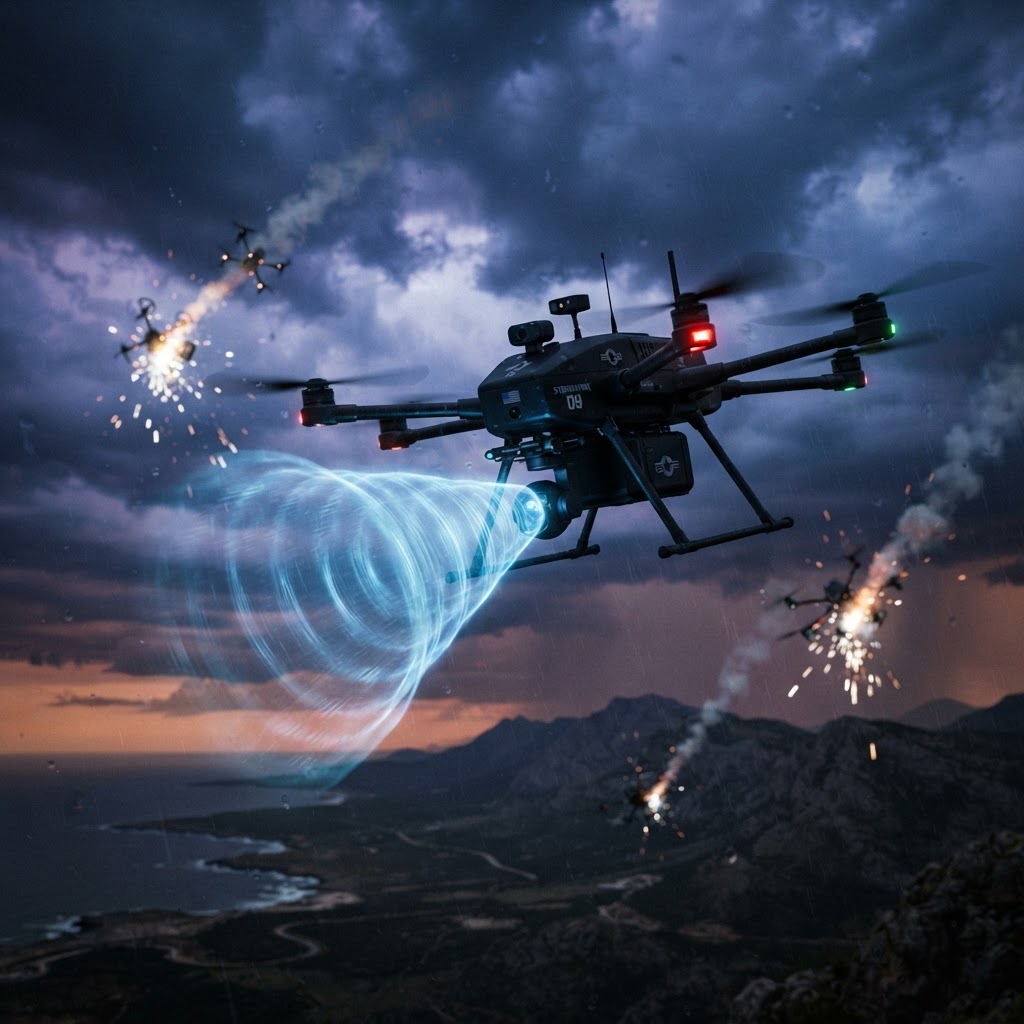
The math of the modern front line is becoming increasingly brutal. As we saw at the Farnborough International Airshow in July 2026, the era of the single-shot interceptor is fading. Lockheed Martin’s reveal of the MORFIUS X-Rotor—an airborne high-power microwave (HPM) drone capable of neutralizing more than 50 targets in a single flight—signals a definitive shift in the electronic warfare (EW) landscape. We are moving away from ground-based 'bubble' defenses toward proactive, airborne electromagnetic hunters. The core question for 2026 isn't just how to jam a drone, but how to physically disable its circuitry when it isn't even listening to a radio signal. The answer lies in directed energy systems that can be deployed at the tactical edge, providing both a shield for friendly forces and a spear for suppressing enemy air defenses.
The Death of the Traditional Jammer
For years, electronic warfare was a game of 'hide and seek' played across radio frequencies. If you could find the link between the pilot and the drone, you could break it. But the game changed in early 2026. Epirus demonstrated that their Leonidas HPM system could successfully disable fiber-optic guided drones—a class of threat previously thought to be 'un-jammable' because they don't rely on RF links. Furthermore, the widespread adoption of AI-guided terminal homing means that even if you jam the GPS and the command link, the drone’s onboard computer can still fly it into the target. This is where drone-mounted electronic warfare becomes essential. By putting the effector on a mobile platform, we can intercept these autonomous threats far from the high-value assets they are targeting, using brute-force electromagnetic pulses to induce currents that fry flight controllers and motor ESCs instantly.
From Defense to Suppression: The SEAD Shift
While much of the public focus remains on counter-UAS, the offensive side of EW is seeing an equally radical transformation. In June 2026, Helsing unveiled the CA-1EA, an autonomous combat aircraft dedicated to electronic attack. This isn't just about self-protection; it’s about Suppression of Enemy Air Defenses (SEAD) and Destruction of Enemy Air Defenses (DEAD). Our own Discombobulator HPM weapon is at the forefront of this dual-use doctrine. When mounted on a loitering platform, the Discombobulator can act as a surgical tool for SEAD, flying into contested airspace to disable enemy radar emitters and communication nodes without firing a single kinetic round. This 'soft kill' capability allows for the degradation of integrated air defense systems (IADS) while minimizing collateral damage and keeping the electromagnetic spectrum clear for friendly operations.
Networked Intelligence and Threat Assessment
The hardware is only half the story. As Anduril demonstrated with the Pulsar system at the World Defense Show earlier this year, modern EW nodes must be networked and software-defined. A single HPM pulse is effective, but a fleet of drones sharing real-time signal data is a force multiplier. These systems perform constant threat assessment, identifying novel waveforms and autonomous flight patterns in milliseconds. Once a new threat is identified, the networked fleet can adjust its HPM output parameters—frequency, pulse width, and power—to ensure maximum lethality against that specific hardware. This rapid iteration is the only way to stay ahead of the 'mutation' rate of commercial-off-the-shelf drones being weaponized in global hotspots.
The Future is Directed
As we look toward the final quarter of 2026, the trend is clear: the electromagnetic spectrum is the primary domain of conflict. Whether it is Turkey’s STM executing 20-unit live-fire swarm attacks or the U.S. Army deploying directed energy to five major bases, the reliance on kinetic interceptors is decreasing. The Discombobulator represents the next logical step in this evolution—a compact, high-efficiency HPM payload that turns any medium-lift drone into a dominant EW platform. The ability to switch from a defensive counter-swarm role to an offensive electronic attack mission mid-flight is no longer a luxury; it is a requirement for survival in the modern battlespace.
If you are looking to integrate advanced directed energy capabilities into your fleet or need a consultation on the latest electromagnetic threats, please contact Silent Pulse Labs.