The Airborne Microwave Shift: Why Lockheed’s Morfius X-Rotor Changes the C-UAS Math
As fiber-optic drones render traditional jamming obsolete, the shift toward airborne high-power microwave (HPM) systems like the Morfius X-Rotor is redefining both defensive swarming and offensive electronic attack.
The End of the Jamming Era
For years, the electronic warfare community relied on a simple premise: if you can sever the radio-frequency (RF) link between a drone and its operator, the threat is neutralized. That era is ending. The recent emergence of fiber-optic guided FPV drones—which Russian forces have reportedly fielded with ranges up to 50 kilometers—has created a massive operational gap. Because these drones are physically tethered to their controllers, they are entirely immune to traditional jamming and spoofing. According to recent reports, the Epirus Demos First Directed-Energy Takedown of Jam-Proof Fiber-Optic Drone proved that only directed energy can reliably close this gap. By delivering software-defined electromagnetic pulses, high-power microwave (HPM) systems fry the internal circuitry of the drone itself, regardless of how it is controlled. This shift is driving the military to move HPM payloads off the ground and into the sky.
Technical Breakdown: The Morfius X-Rotor
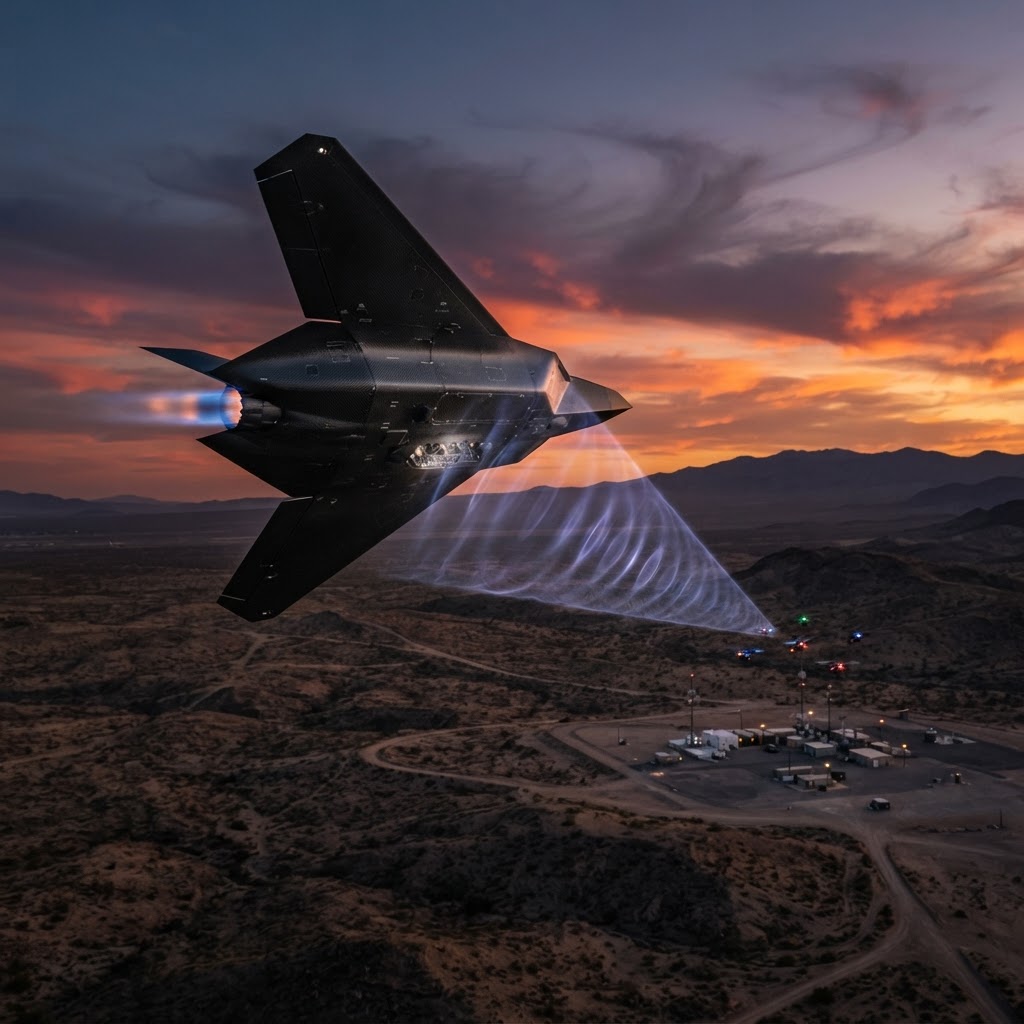
In July 2026, Lockheed Martin accelerated the production of its Morfius X-Rotor, a reusable, airborne HPM interceptor designed to engage swarms of up to 50 drones in a single flight. As detailed in Lockheed Martin’s Morfius X-Rotor built to fry 50 enemy drones in one flight, the system is sensor-agnostic and built for field recovery. Unlike ground-based systems like the Leonidas AGV, which are limited by the horizon and physical obstacles, an airborne HPM platform can position itself above or adjacent to an incoming swarm. This geometry allows for a more efficient 'cone of effect,' ensuring that the microwave energy hits the most vulnerable seams in a drone's fuselage. Our own Discombobulator HPM weapon follows a similar design philosophy, utilizing a lightweight architecture that allows for rapid deployment on medium-altitude, long-endurance (MALE) platforms.
From Defense to Offense: SEAD and DEAD
While much of the public focus remains on counter-drone HPM systems, the real technical evolution is happening on the offensive side. Airborne HPM is becoming a cornerstone of Suppression and Destruction of Enemy Air Defenses (SEAD/DEAD). By mounting HPM payloads on stealthy or high-speed drones, military forces can now conduct 'electronic suppression' without the collateral damage of high explosives. A drone equipped with drone-mounted electronic warfare capabilities can fly into a contested area and systematically disable radar arrays, communication nodes, and even the sensors of larger surface-to-air missile batteries. This 'soft kill' capability is essential for clearing corridors for follow-on manned aircraft or larger drone strikes, effectively turning a defensive tool into a primary offensive asset.
Why HPM Beats Lasers for Swarm Defense
While the U.S. Army is also pursuing high-energy lasers like the LOCUST X3, HPM offers distinct advantages for the modern multi-threat environment:
Area of Effect: Lasers are 'point' weapons that must dwell on a single target to burn through it. HPM creates a wide-angle beam that can drop dozens of drones simultaneously.
Weather Resilience: Lasers suffer from beam attenuation in fog, smoke, or rain. Microwaves penetrate atmospheric interference with significantly less power loss.
Cost Per Engagement: As noted in A Counter to Drone Swarms: High-Power Microwave Weapons, the cost per shot is measured in cents, not the thousands of dollars required for kinetic interceptors.
Speed of Engagement: HPM travels at the speed of light and requires minimal 'dwell time' to achieve a lethal effect on sensitive electronics.
The Integration Challenge
The technical hurdle isn't just the microwave generator; it's the integration. Modern HPM systems must be able to distinguish between friend and foe in a crowded electromagnetic environment. This requires a sophisticated threat assessment protocol that links the HPM effector to the broader battle management system. Lockheed's Morfius and our Discombobulator are designed to be 'plug-and-play' with existing command and control networks, allowing operators to trigger the HPM pulse only when a confirmed hostile signature is detected. This prevents the accidental 'frying' of friendly assets that might be operating in the same airspace—a critical requirement as we move toward fully autonomous drone-on-drone combat.
Looking Ahead
As we move toward the end of 2026, the proliferation of HPM technology will likely force a redesign of drone hardware globally. We are already seeing a race to develop 'hardened' electronics, but the physics of HPM—which exploits the very antennas and wires a drone needs to function—makes total shielding nearly impossible. The airborne microwave isn't just a new weapon; it's a fundamental shift in how we control the low-altitude sky.