Beyond Jamming: Why High-Power Microwave is the New Standard for Counter-UAS
As FPV drones and swarms evolve to bypass traditional radio-frequency jamming, militaries are pivoting to high-power microwave systems to secure the electromagnetic spectrum.
The End of the Jamming Era
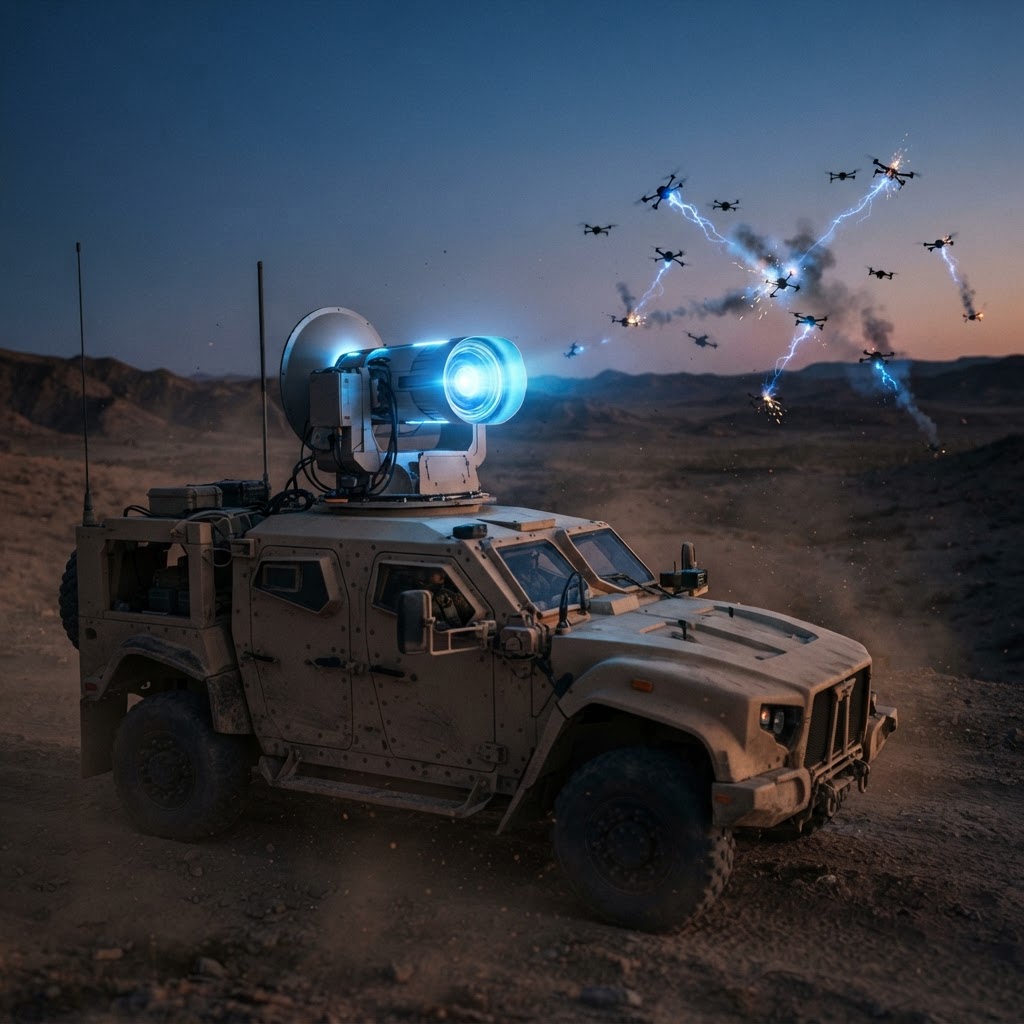
The cat-and-mouse game of electronic warfare has hit a wall. For years, we relied on radio-frequency (RF) jamming to sever the link between a drone and its pilot. But with the rise of fiber-optic controlled FPVs and autonomous, AI-driven swarms, traditional jamming is increasingly ineffective. The new reality is clear: to stop a modern drone threat, you don't just need to disrupt its signal—you need to fry its electronics. This is why the Discombobulator HPM weapon and similar counter-drone HPM systems are moving from experimental labs to the front lines of modern maneuver warfare.
The Physics of Overmatch
Unlike narrow-band jammers that can be defeated by frequency hopping or physical cables, high-power microwave (HPM) systems deliver a broad-spectrum pulse that induces damaging currents directly into a drone's circuitry. It is the ultimate electromagnetic spectrum warfare tool. Whether it is the U.S. Marine Corps' HAVOC program or the latest deployments on light infantry vehicles, the goal is the same: scalable, non-kinetic point defense. By integrating these systems into a unified command and control architecture, commanders can now neutralize entire swarms in a single burst, rather than wasting expensive interceptors on low-cost targets.
Operational Advantages of HPM
Key benefits of integrating HPM into modern tactical units include:
Instantaneous neutralization of drone swarms without the need for precise targeting.
Reduced reliance on expensive kinetic interceptors for small, low-cost threats.
Ability to perform SEAD/DEAD missions by disabling enemy sensor arrays.
Seamless integration with existing vehicle platforms for mobile, expeditionary defense.
Offense Meets Defense
While we often discuss HPM in the context of defense, its offensive potential is equally disruptive. A drone-mounted electronic warfare suite equipped with HPM allows a platform to clear a path through enemy air defenses by blinding radar and communications nodes. When paired with a robust threat assessment engine, these systems can prioritize targets in real-time, ensuring that the most dangerous threats are neutralized before they can engage. It is a fundamental shift in how we view the battlefield—moving away from static defense toward a dynamic, energy-based dominance.
Looking Ahead
The battlefield of 2026 is defined by the proliferation of cheap, lethal, and increasingly autonomous drones. If your unit is still relying solely on legacy jamming, you are already behind the curve. The future belongs to those who can master the microwave spectrum. If you are ready to discuss how your force can integrate these capabilities, contact Silent Pulse Labs to learn more about our latest developments.