Beyond Jamming: Why High-Power Microwave Drones Are the New SEAD Standard
As fiber-optic drones render traditional jamming obsolete, Silent Pulse Labs explores how drone-mounted HPM systems are redefining SEAD and counter-UAS operations.
The End of the Jamming Era
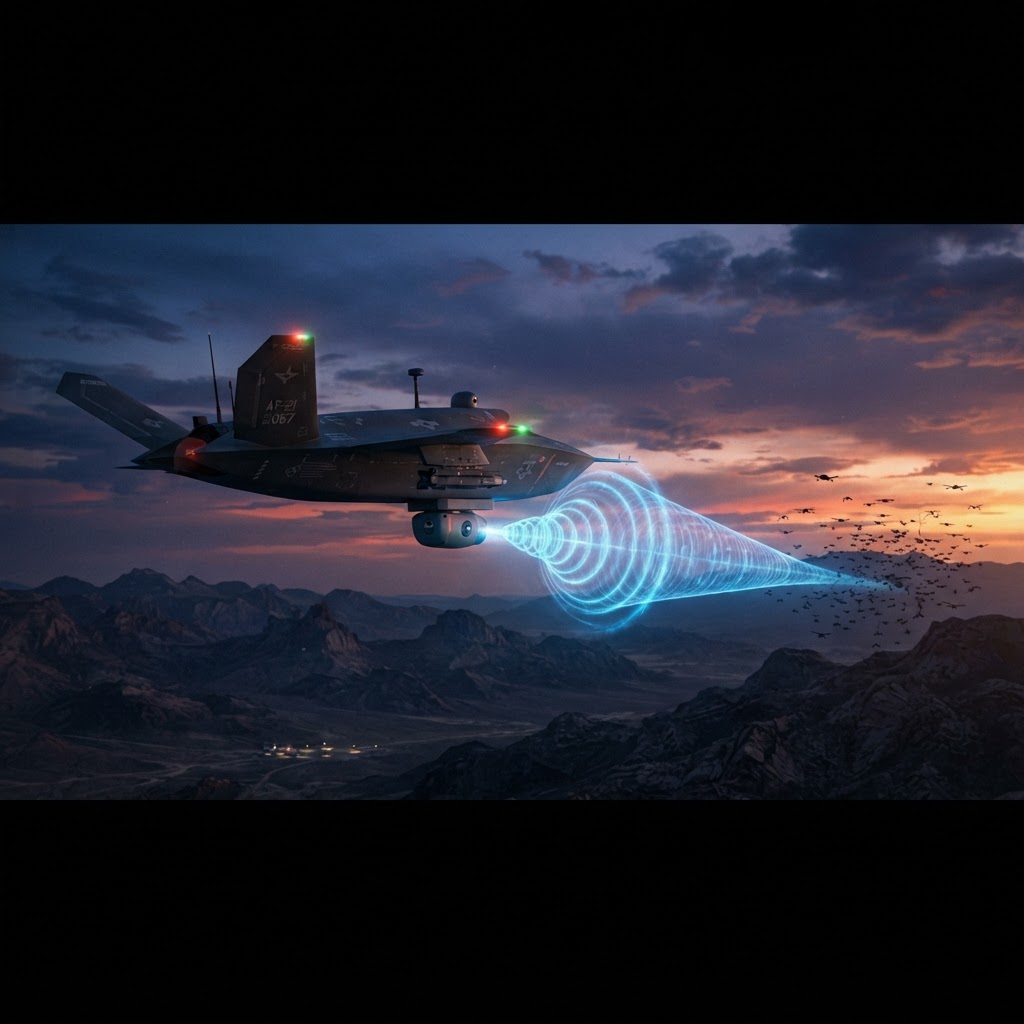
The battlefield has a new problem: the fiber-optic-guided drone. Because these platforms don't rely on radio-frequency links, they are effectively immune to the legacy electronic warfare suites that have defined the last decade of conflict. To stay ahead, the defense sector is shifting toward directed energy, specifically high-power microwave (HPM) technology. Unlike lasers, which require precise tracking and dwell time to burn through a target, HPM systems deliver a wide-area electromagnetic pulse that fries internal circuitry instantly. At Silent Pulse Labs, we have integrated this capability into the Discombobulator HPM weapon, allowing operators to neutralize entire swarms or hardened, wire-guided threats without needing a line-of-sight lock.
Offensive SEAD and the HPM Advantage
We usually talk about HPM in the context of defense, but its true potential lies in SEAD (Suppression of Enemy Air Defenses) and DEAD (Destruction of Enemy Air Defenses). By mounting an HPM emitter on a long-endurance UAS, you create a mobile, airborne electronic attack platform that can loiter over contested airspace. When integrated with a robust command and control suite, the Discombobulator can selectively disable radar arrays and communication nodes while leaving friendly systems untouched. This isn't just about jamming; it is about the permanent, non-kinetic destruction of the enemy's ability to see or command their own battlespace.
Why HPM Outperforms Kinetic Defenses
Key advantages of HPM over traditional kinetic or jamming-based systems include:
Deep Magazine: HPM systems are limited only by power supply, allowing for sustained engagement against massive swarms.
Fiber-Optic Immunity: HPM disables the physical electronics, rendering 'jam-proof' fiber-optic links irrelevant.
Minimal Collateral: Precise beam-forming allows for targeted neutralization in dense urban environments.
Cost-Per-Shot: Eliminates the need for expensive missiles to take down low-cost, mass-produced drones.
Integrating the Spectrum
The future of counter-drone HPM systems isn't just about raw power; it is about intelligent application. Our approach at Silent Pulse Labs focuses on threat assessment algorithms that identify the specific frequency signatures of incoming threats before the HPM pulse is even triggered. This ensures that we aren't just throwing energy into the void, but conducting precise electromagnetic spectrum warfare that preserves the integrity of our own communications. If you are interested in how these systems can be integrated into your current defensive architecture, contact Silent Pulse Labs to discuss our latest field-ready configurations.