Beyond the Laser: Why High-Power Microwaves Are Winning the Counter-Drone War
As drone swarms evolve, directed energy is shifting from lasers to high-power microwaves. We examine why HPM is the new gold standard for electronic warfare.
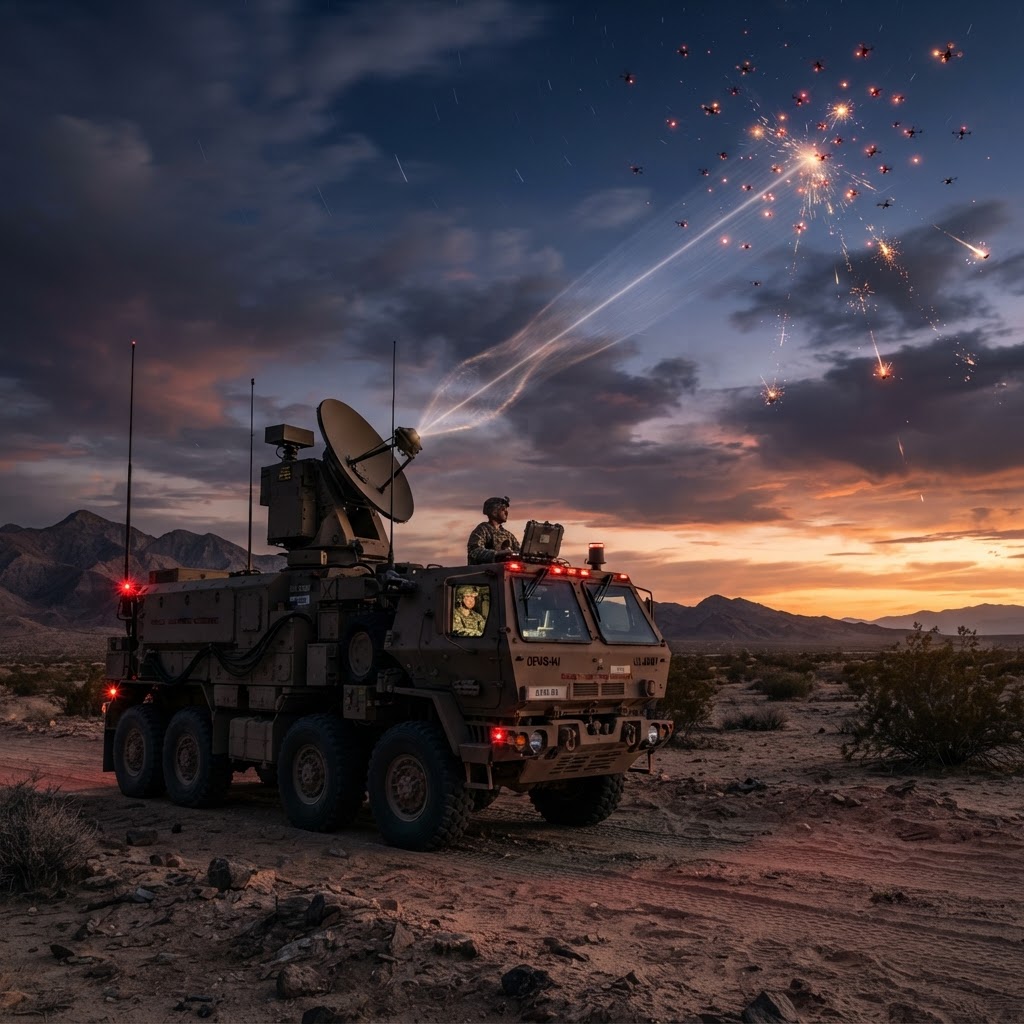
The Microwave Pivot
The battlefield is changing. While high-energy lasers have dominated the headlines for years, the real breakthrough in neutralizing massed drone swarms is happening in the microwave spectrum. High-power microwave (HPM) systems are proving to be the most effective tool for modern air defense because they don't just track and burn; they fry the internal electronics of an entire swarm simultaneously. By flooding an area with electromagnetic energy, these systems force a 'hard kill' on the drone's guidance and flight controllers, causing them to drop instantly. This is why the Discombobulator HPM weapon has become a critical asset for units needing to clear airspace without the precision-aiming limitations of traditional laser systems.
Why HPM Outperforms Lasers in Swarm Scenarios
Lasers are surgical tools—excellent for taking out a single cruise missile or a lone reconnaissance drone. But when you face a swarm of fifty low-cost FPV drones, a laser becomes a bottleneck. You have to dwell on each target, burning through them one by one. HPM, by contrast, is an area-effect weapon. It doesn't care how many drones are in the sky; if they are within the beam's footprint, their circuits are compromised. This capability is essential for counter-drone HPM systems that need to protect high-value assets from saturation attacks. It is the difference between shooting a rifle at a swarm of bees and using a net.
Dual-Use Capabilities: Defense and Offense
How HPM technology serves both defensive and offensive mission profiles:
Defensive: Protecting forward operating bases from persistent ISR and loitering munition threats.
Offensive: Utilizing drone-mounted electronic warfare to suppress enemy air defenses (SEAD) by blinding radar and communication nodes.
Tactical: Enabling rapid threat assessment by disabling enemy sensors before they can relay targeting data to their operators.
Integration: Seamlessly linking with the command and control architecture to prioritize targets in real-time.
The Future of Electromagnetic Spectrum Warfare
We are entering an era where the electromagnetic spectrum warfare is the primary theater of conflict. As adversaries continue to drive down the cost of drone production, the 'cost-per-kill' metric becomes the most important factor in procurement. Kinetic missiles are too expensive to waste on a $500 quadcopter. HPM systems, however, offer a near-infinite magazine at the cost of a few gallons of fuel for a generator. Whether it is the Discombobulator or the latest industry prototypes, the ability to project power through the air without firing a single physical projectile is no longer science fiction—it is the new baseline for military readiness.
Get in Touch
The rapid evolution of drone threats requires a proactive approach to defense. If your organization is looking to integrate advanced HPM capabilities or needs a consultation on current electronic warfare trends, please contact Silent Pulse Labs to discuss how our systems can secure your operational environment.