Microwave Dominance: The New Era of Counter-Swarm Warfare
As drone swarms evolve, high-power microwave technology is shifting from experimental to essential. We examine the latest HPM developments and the role of the Discombobulator in modern air defense.
The Microwave Pivot
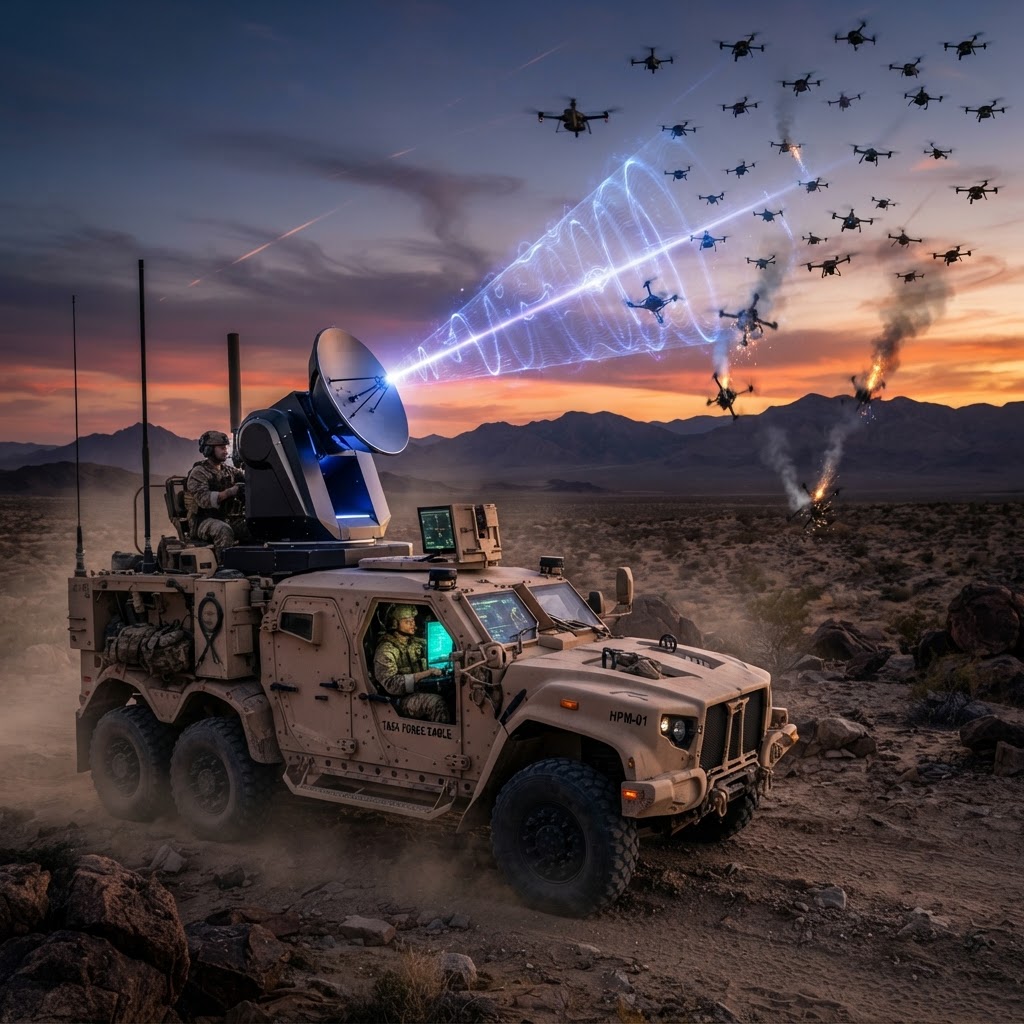
The battlefield has reached a saturation point. With low-cost, AI-enabled drone swarms becoming the primary threat to tactical formations, traditional kinetic interceptors are proving too expensive and too slow. The solution currently gaining traction across global militaries is high-power microwave (HPM) technology. By emitting focused electromagnetic energy, these systems can disable the internal electronics of multiple drones simultaneously, effectively neutralizing a swarm without firing a single kinetic round. This shift is best exemplified by the recent $11 million USMC contract for the HAVOC program, which aims to integrate HPM capabilities directly onto ground vehicle fleets. For operators, this means the Discombobulator HPM weapon is no longer just a defensive asset; it is a critical tool for threat assessment and active suppression in contested environments.
From Defense to Offensive Suppression
While most headlines focus on the defensive utility of counter-drone HPM systems, the true potential of this technology lies in its offensive versatility. In SEAD/DEAD (Suppression/Destruction of Enemy Air Defenses) missions, HPM platforms can be used to blind enemy sensors and disrupt command and control nodes before a strike package even enters the engagement zone. The Discombobulator excels here, providing a surgical method to degrade enemy electronic infrastructure. Unlike traditional jamming, which often requires sustained transmission, HPM pulses can cause permanent, irreversible damage to sensitive circuitry, effectively removing the threat from the board entirely.
Key Developments in 2026
Recent milestones highlight the transition of HPM from the lab to the field:
USMC HAVOC Program: A new $11 million contract to integrate HPM onto ground vehicles for scalable point defense.
Lockheed Martin MORFIUS X-Rotor: An airborne HPM system capable of neutralizing over 50 drones in a single sortie.
Global Proliferation: China’s deployment of the Hurricane 3000, signaling that HPM is now a standard component of modern air defense architectures.
US Military Trials: A yearlong, five-base assessment to determine the sustainability of HPM alongside kinetic and electronic warfare systems.
The Future of the Spectrum
The integration of drone-mounted electronic warfare into the broader electromagnetic spectrum warfare strategy is the next logical step. As we move toward 2027, the ability to manage these high-energy outputs while maintaining situational awareness will define the winners of the next conflict. Silent Pulse Labs remains at the forefront of this transition, ensuring that our systems provide the precision required for modern, complex battlefields. If you are interested in how our technology can be integrated into your current operational framework, please contact Silent Pulse Labs to discuss our latest hardware configurations.