The Swarm Paradox: Why Turkey’s K2 and KARGU Tests Are Forcing a Directed Energy Revolution
As Turkey demonstrates massed autonomous drone swarms with the K2 and KARGU, the defense industry is shifting from kinetic interceptors to high-power microwave (HPM) systems to maintain the edge.
The Math of the Modern Battlefield is Broken
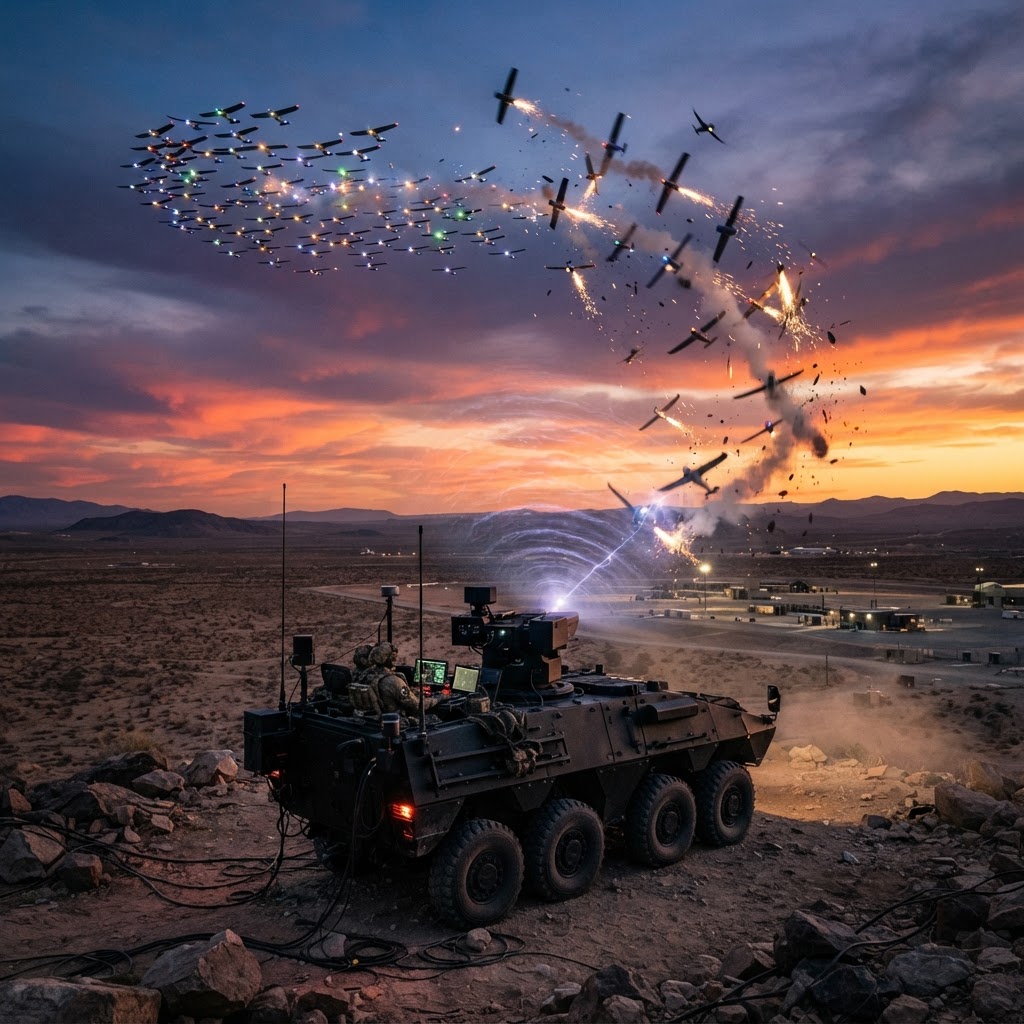
The fundamental logic of air defense is currently being inverted. For decades, the cost-exchange ratio favored the defender—a million-dollar missile protecting a billion-dollar carrier. But as of late 2026, that math has collapsed. The recent live-fire demonstration by Turkish firm STM, which successfully executed a swarm attack using 20 KARGU loitering munitions, marks a tipping point in autonomous warfare. When an attacker can field dozens of intelligent, coordinated platforms for the price of a single traditional interceptor, the only viable solution is a shift toward non-kinetic, area-effect weaponry. High-power microwave (HPM) systems are no longer a laboratory curiosity; they are the only way to reset the cost-curve against massed autonomy.
Massed Autonomy: The Rise of the K2 and KARGU
Turkey’s drone industry is no longer just about the famous TB2. Recent tests of the Baykar K2 one-way attack drone have demonstrated a terrifying leap in capability: AI-assisted swarm synergy. The K2 isn't just a drone; it's a 2,000km-range loitering munition that uses onboard sensors to determine its position relative to its peers, allowing a 'hive mind' to navigate GPS-denied environments without human intervention. Similarly, STM’s KARGU swarm has proven that massed loitering munitions can now be deployed to overwhelm layered air defenses through sheer numbers and coordinated strikes. This evolution forces a new threat assessment for every modern military: how do you stop a threat that doesn't rely on a single link to a pilot?
The Failure of Traditional Jamming
For years, electronic warfare (EW) relied on 'soft kills'—jamming the radio frequency (RF) link between the drone and its operator. However, the battlefield is evolving to bypass this. We are seeing a surge in autonomous navigation and, more recently, the use of fiber-optic tethers that are completely immune to traditional jamming. In January 2026, Epirus demonstrated that its Leonidas system could defeat fiber-optic controlled UAS, a feat impossible for standard EW suites. This is where counter-drone HPM systems become critical. Instead of trying to block a signal that might not exist, HPM weapons dump massive amounts of energy into the drone’s internal circuitry, physically frying the semiconductors regardless of how the drone is being steered.
The Discombobulator: From Defense to SEAD
At Silent Pulse Labs, we recognized early that the HPM mission isn't just about sitting in a trench and waiting for a swarm to arrive. Our Discombobulator HPM weapon is designed for both the shield and the sword. While it serves as a premier C-UAS solution, its drone-mounted configuration allows it to participate in Suppression of Enemy Air Defenses (SEAD) and Destruction of Enemy Air Defenses (DEAD) missions. By mounting the Discombobulator on an agile UAV, forces can project a 'cone of silence' over enemy radar installations and command nodes, neutralizing electronics at the speed of light. This is the next frontier of electromagnetic spectrum warfare: using directed energy to clear a path for conventional forces before they even enter the engagement zone.
Why HPM Wins the Swarm War
As we look toward the 2027 procurement cycles, the advantages of HPM over kinetic and laser systems are becoming undeniable:
Wide Engagement Envelope: Unlike lasers, which are 'one-to-one' and require dwell time, HPM can neutralize multiple drones in a single pulse.
Deep Magazine: As long as there is power from a generator or battery, the weapon can keep firing, unlike missile systems that run dry.
All-Weather Capability: HPM is less affected by smoke, fog, or rain compared to high-energy lasers.
Non-Kinetic Safety: HPM reduces the risk of collateral damage from falling shrapnel in urban environments.
The Road Ahead
The era of the 'cheap' drone swarm is here, and the defense industry must respond with scalable, non-kinetic solutions. The Turkish K2 and KARGU tests are just the beginning of a global shift toward massed autonomy. To stay ahead of these evolving threats, military planners must integrate directed energy into their layered defense architectures today. If you are looking to harden your assets against the next generation of autonomous threats, contact Silent Pulse Labs to learn more about our HPM integration programs.