US Army Signals New Era with First-Ever Production Contract for Laser Weapons
The US Army has awarded AeroVironment a historic $464.8 million contract for the LOCUST laser system, marking the transition of directed energy from prototype to permanent arsenal.
From Prototype to Program of Record
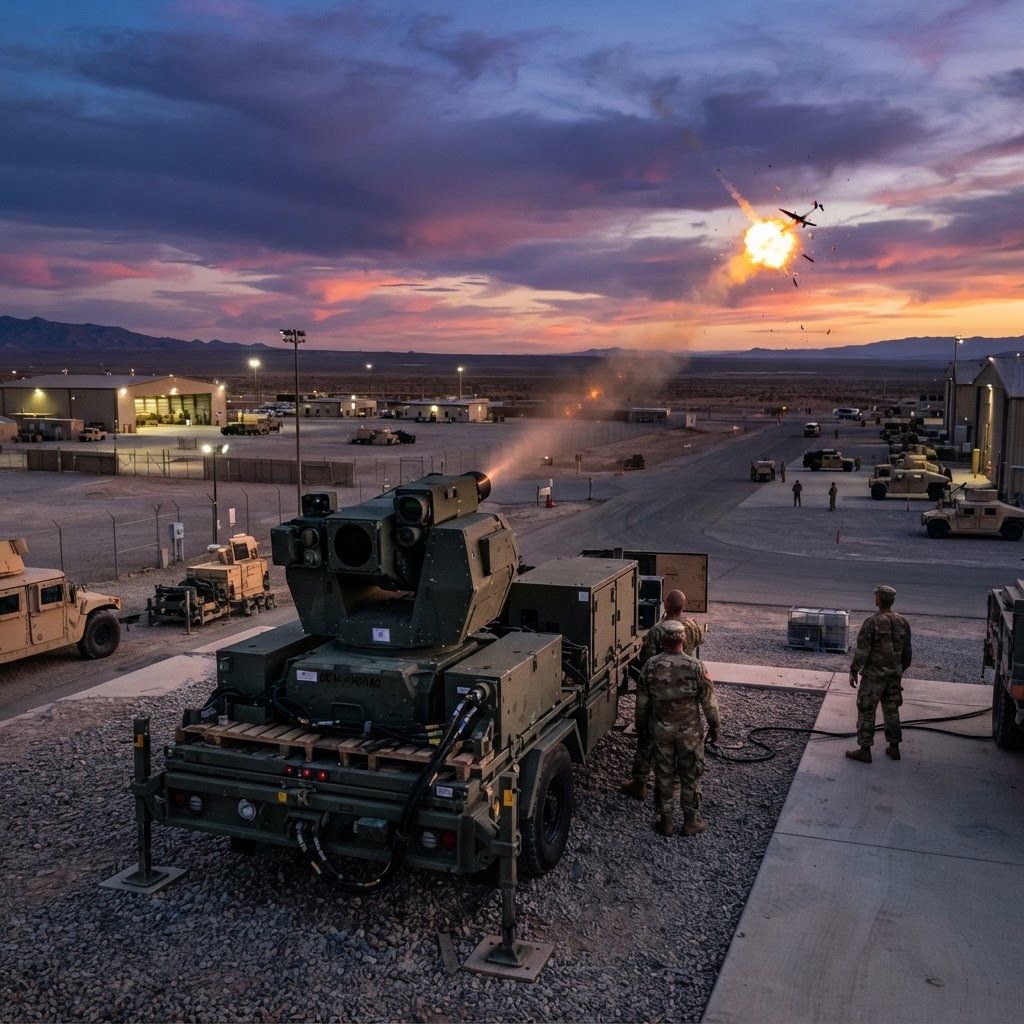
The U.S. Army has officially moved directed energy from the laboratory to the assembly line. On September 3, 2026, the service awarded AeroVironment a $464.8 million production contract for the LOCUST laser weapon system. This marks the first time in U.S. military history that a directed energy (DE) system has transitioned into a formal program of record for mass production. The contract, part of the Enduring-High Energy Laser (E-HEL) program, signals a fundamental shift in how the Pentagon intends to manage the growing threat of unmanned aerial systems (UAS). For years, laser systems were viewed as experimental 'science projects' relegated to testing ranges, but this award confirms that the technology is now considered mature enough for sustained frontline operations.
The LOCUST System: Precision at the Speed of Light
The LOCUST system is a 30-kilowatt high-energy laser designed to intercept and neutralize Group 1, 2, and 3 drones—platforms ranging from small quadcopters to mid-sized fixed-wing aircraft weighing up to 1,320 pounds. Unlike traditional kinetic interceptors that rely on physical projectiles, the LOCUST focuses a concentrated beam of light to burn through airframes or fry sensitive optical sensors. Its primary advantage is the 'deep magazine.' As long as the system has access to a stable power source, it can continue to fire indefinitely, effectively decoupling the cost of defense from the cost of the interceptor. This is a critical capability in modern electromagnetic spectrum warfare, where the ability to sustain defensive fire against persistent threats is paramount.
Correcting the Economic Imbalance of Drone Warfare
This development comes at a critical juncture for global defense strategy. For the past decade, the cost-exchange ratio has heavily favored the attacker; a $2,000 off-the-shelf drone could force the expenditure of a $2 million Patriot missile or a $100,000 Stinger. By moving to production, the Army is betting that lasers can finally correct this economic imbalance, reducing the cost per engagement to mere pennies in electricity. However, lasers are not a silver bullet. They are primarily point-defense tools, requiring a steady 'dwell time' on a single target to achieve a kill. This limitation highlights the need for a layered defense architecture that includes both precision lasers and broader area-effect weapons.
The Role of Mobile HPM in Layered Defense
While ground-based lasers like LOCUST provide exceptional perimeter security, the evolving battlefield requires more mobile and aggressive non-kinetic options. This is where the Discombobulator enters the tactical picture. As a Discombobulator HPM weapon, our system offers a distinct advantage by being drone-mounted rather than tethered to a ground vehicle. While a laser must track one target at a time, the Discombobulator can be deployed forward for Suppression of Enemy Air Defenses (SEAD) or Destruction of Enemy Air Defenses (DEAD). It uses wide-beam electromagnetic pulses to disable entire clusters of electronics simultaneously, making it an ideal tool for offensive electronic attacks against enemy command nodes or defensive counter-swarm operations.
Integrating Directed Energy into the Modern Force
The integration of these systems represents a new standard for counter-drone HPM systems. In a high-intensity conflict, a ground-based laser might pick off larger, high-altitude threats, while a swarm of Discombobulator-equipped drones could perform electronic maneuvers to neutralize incoming swarms before they even reach the inner defensive layer. The Army's contract with AeroVironment is the first domino to fall in a much larger restructuring of the tactical battlefield, where non-kinetic effects will soon be as common as small arms fire. The transition from prototypes to fielded systems is accelerating, and the demand for versatile, non-kinetic solutions that can operate across the full spectrum of conflict will only continue to grow.
Future Outlook
As the U.S. Army begins fielding the LOCUST system over the next few years, the lessons learned from its deployment will likely shape the next generation of directed energy requirements. The focus will shift toward increasing power levels to engage larger threats and miniaturizing components for even greater mobility. For defense planners, the message is clear: directed energy is no longer the future—it is the present. To learn more about how our high-power microwave solutions can integrate into your defense architecture, contact Silent Pulse Labs.