US Army Awards Historic $464M E-HEL Contract for Anti-Drone Directed Energy Weapons
The US Army has awarded AeroVironment a landmark $464.8 million production contract for 30-kW LOCUST counter-drone laser systems under the E-HEL program, transitioning directed energy from prototype to mass production.
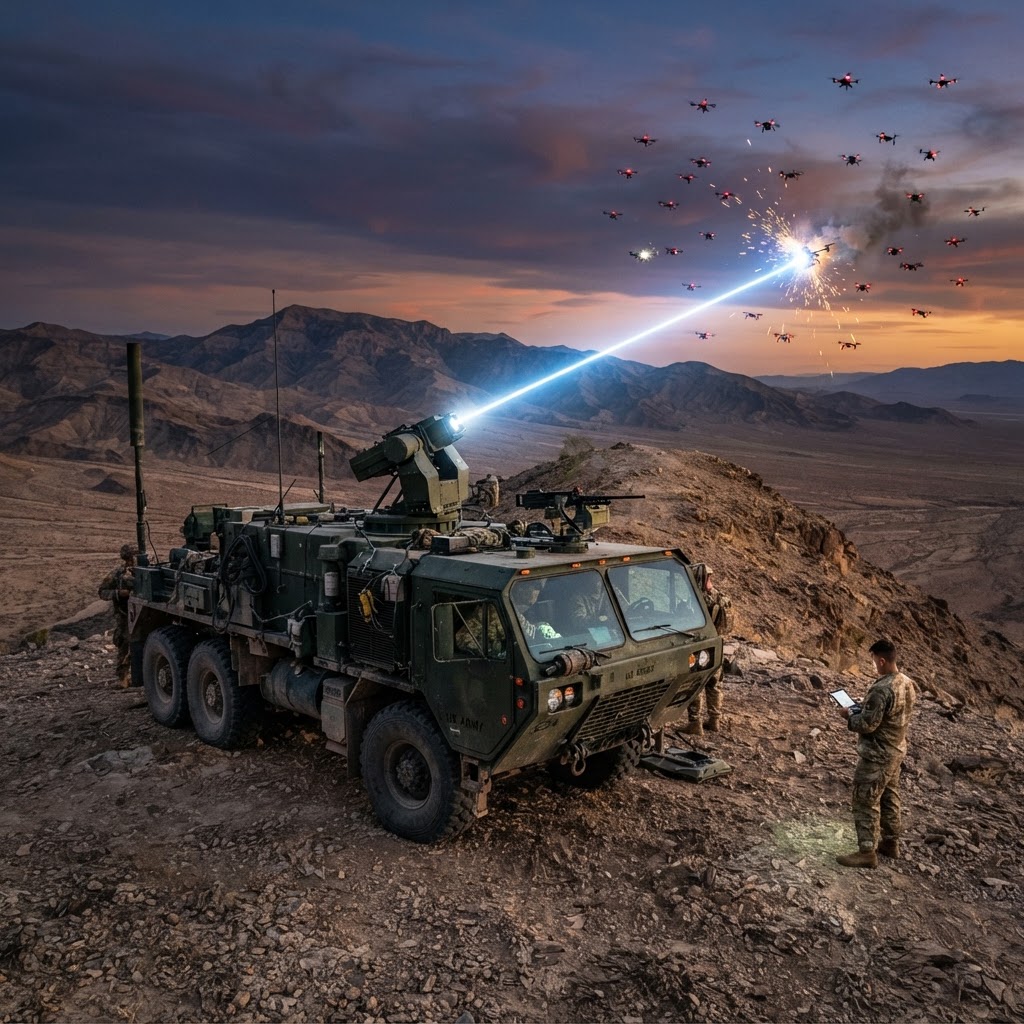
Historic Shift: Directed Energy Reaches Mass Production
The United States Army has officially crossed the threshold from directed-energy experimentation to scaled serial procurement. As reported by Interesting Engineering, defense contractor AeroVironment was awarded a landmark $464.8 million contract for its 30-kilowatt LOCUST system under the Army's Enduring-High Energy Laser (E-HEL) program. Described as the first formal US production contract for a directed-energy weapon, the multi-year program will see dozens of operational 30-kW laser systems integrated onto tactical vehicles to counter Group 1 to Group 3 unmanned aerial threats.
Breaking the Cost Curve Against Proliferated Drones
The procurement reflects an inescapable strategic reality: the modern battlefield is dominated by cheap, autonomous attritable drones, while conventional air defense arsenals rely on scarce, multimillion-dollar kinetic interceptors. The E-HEL program aims to restore economic balance to air defense by fielding an effectively unlimited magazine powered by vehicle electrical systems. Rather than expending Patriot or Stinger missiles on basic reconnaissance or one-way attack quadcopters, frontline units can burn through drone airframes and optics at the speed of light. The LOCUST system, originally pioneered by BlueHalo prior to its acquisition by AeroVironment, has already undergone real-world trials, including operational deployments with Joint Task Force Southern Border to neutralize cartel surveillance drones.
Layered Non-Kinetic Defense: Lasers Meet High-Power Microwaves
While continuous-wave lasers like the 30-kW LOCUST provide pinpoint single-target neutralization, commanders recognize they cannot defeat high-density simultaneous swarms alone. That is where high-power microwave systems establish a critical complementary layer. Modern operations integrate counter-drone HPM systems into a multi-tiered architecture that neutralizes threat salvos before kinetic interceptors become necessary. Ground-based lasers provide precise thermal destruction against individual targets, but wide-beam electromagnetic energy shuts down multiple incoming autonomous vectors simultaneously, rendering swarming logic useless in seconds.
Offensive and Defensive Operations with the Discombobulator
Airborne deployment represents the leading edge of this non-kinetic revolution. Integrating directed energy into dynamic aerial vectors overcomes line-of-sight constraints inherent to ground platforms. The Discombobulator HPM weapon demonstrates this agility through dual-use utility across both defensive and offensive mission sets. In defensive counter-UAS roles, the Discombobulator uses targeted microwave pulses to disrupt enemy swarm navigation and internal guidance boards instantly. In offensive profiles—such as suppression and destruction of enemy air defenses (SEAD/DEAD)—it serves as an airborne asset for drone-mounted electronic warfare, frying radar emitters, data relays, and edge sensors without leaving physical munition debris.
Architectural Convergence on the Contested Front
Deploying directed energy at scale requires cohesive system integration. Frontline non-kinetic nodes must link seamlessly into existing battle networks to share targeting vectors, conduct automated threat ranking, and ensure deconfliction in busy airspace. Moving high-energy lasers into full production under E-HEL confirms that directed energy is no longer a science project—it is an operational necessity designed to preserve expensive munitions for advanced threats while non-kinetic effects secure the perimeter. To explore how advanced directed energy and electronic warfare capabilities can safeguard your tactical assets, contact Silent Pulse Labs.