US Army Awards Historic $465M Laser Production Contract as Directed Energy Counters Drone Swarms
The U.S. Army has issued its first full-scale production contract for a directed-energy weapon, awarding $464.8 million to AeroVironment for the Enduring-High Energy Laser (E-HEL) system to defeat adversarial drone swarms.
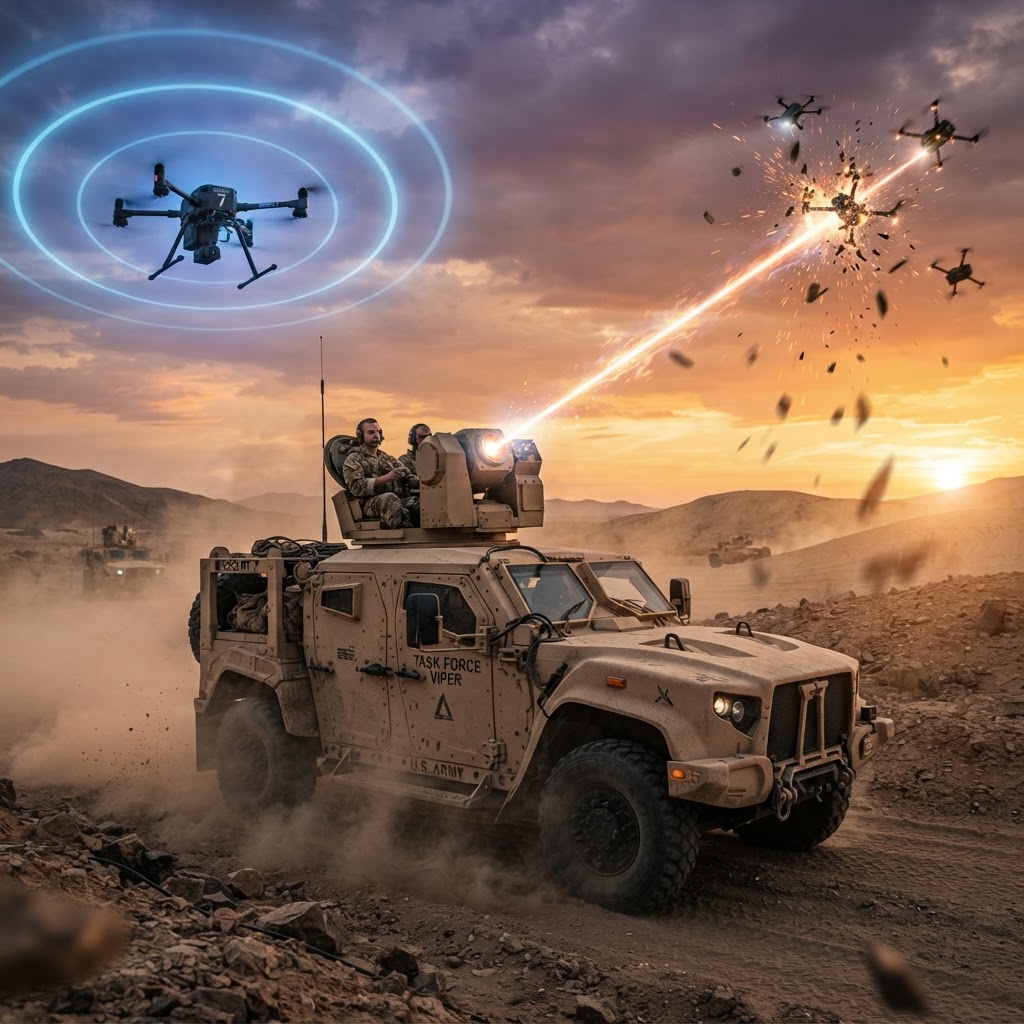
The U.S. Army Crosses the Directed-Energy Production Rubicon
The U.S. Army awarded a $464.8 million production contract to AeroVironment for the Enduring-High Energy Laser (E-HEL) program on September 3, 2026, marking the first time in military history that a directed-energy weapon system has entered full-scale series procurement. The award, reported by Defense News, formally transitions beam-based counter-unmanned aircraft systems (C-UAS) from specialized science projects into mainstream military inventory. The contract delivers the LOCUST X3 laser system, designed to integrate seamlessly onto Joint Light Tactical Vehicles (JLTV) to eliminate aerial threats at the speed of light.
Operational Realities Shift Beyond Kinetic Interceptors
The decision to field production lasers comes on the heels of active operational validation across multiple operational theaters. On August 25, 2026, Joint Task Force – Southern Border utilized an Army Multipurpose High Energy Laser (AMP-HEL) unit to actively neutralize cartel-linked surveillance drones, establishing an operational precedent for beam weapons inside domestic air defense corridors. Using traditional interceptor missiles costing upwards of several hundred thousand dollars per engagement against attritable commercial drones is an unsustainable strategy. Modern air defense requires directed energy and dedicated counter-drone HPM systems that offer virtually unlimited magazines governed only by the platform's thermal and electrical power reserve.
Lasers vs. Microwaves: The Non-Kinetic Layered Architecture
While high-energy lasers like the LOCUST X3 deliver concentrated thermal energy to burn optical sensors, cut control surfaces, and detonate munitions on single targets, they face fundamental physical limits when confronting coordinated saturation raids. Concentrated photon beams require a sustained dwell time on each hostile hull. When hostile forces launch dozens of autonomous micro-drones simultaneously, point-defense lasers must hand off targets to wide-area non-kinetic systems. This is where drone-mounted electronic warfare and high-power microwave systems establish superiority across the contested theater.
The Dual Role of Drone-Mounted HPM: Discombobulator in Action
To counter dense drone incursions where line-of-sight laser tracking reaches its operational saturation threshold, mobile electromagnetic disruption becomes mandatory. Silent Pulse Labs addresses this operational gap with the Discombobulator HPM weapon, an airborne high-power microwave payload engineered for agile UAS platforms. Operating defensively, the Discombobulator acts as an umbrella effector, unleashing broad electromagnetic bursts that fry microelectronics, corrupt flight controllers, and neutralize entire incoming drone swarms in mid-air. Offensively, the same system transitions into a precision strike asset for Suppression and Destruction of Enemy Air Defenses (SEAD/DEAD), allowing friendly forces to disable enemy radar apertures, frontline communications, and tactical sensor nodes without causing civilian structural collateral damage.
Building the Future Electromagnetic Battlefield
Modern defensive operations cannot rely on solitary effectors. True survivability emerges when tactical commanders unify beam-forming lasers, drone-borne microwaves, and specialized command and control suites into a synchronized kill web. By weaving together high-energy lasers for discrete hard-kills and agile high-power microwave systems for wide-area disruption, forward-deployed units can maintain air superiority against both commercial adaptations and military-grade drone swarms. To explore how directed energy and next-generation airborne payloads can safeguard your installations and assets, contact Silent Pulse Labs to consult with our defense engineering specialists.