US Army Awards Historic $465M Counter-UAS Laser Production Contract Following Border Intercepts
Following operational intercepts of cartel-linked surveillance drones along the southern border, the US Army has awarded a $464.8 million directed-energy contract for the LOCUST laser system.
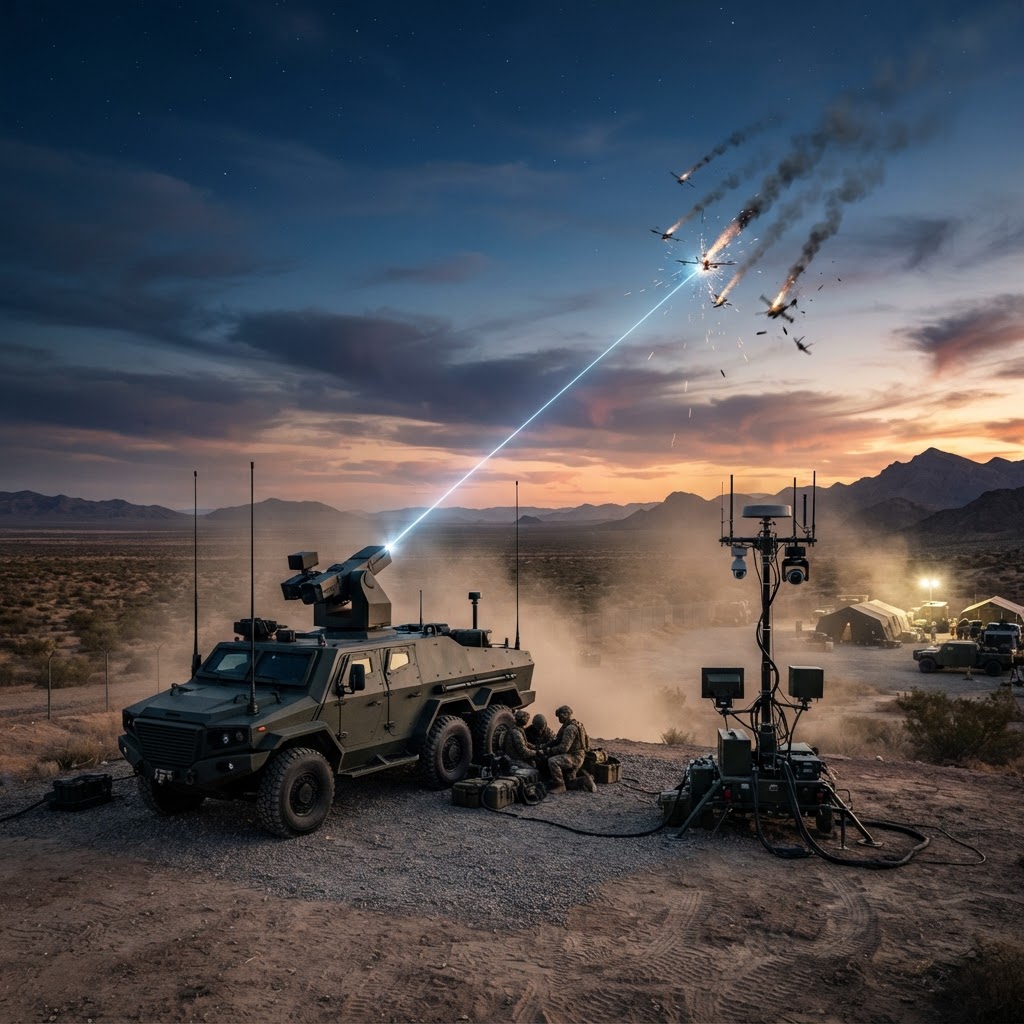
Operational Laser Intercepts Trigger First Historic Production Award
The United States Army has officially transitioned directed-energy air defense from experimental testbeds into full-rate production. Following successful operational engagements against hostile, cartel-linked surveillance drones near the U.S. southern border in late August 2026, the service awarded a $464.8 million contract for the LOCUST directed-energy weapon system under the Enduring-High Energy Laser (E-HEL) program. Detailed in reporting by The Next Web and program updates from AeroVironment, the historic acquisition marks the first formal production-scale contract for high-energy counter-drone lasers in American military history.
The procurement comes on the heels of actions by Joint Task Force Southern Border, where soldiers used an Army Multipurpose High Energy Laser capability to track and down three intruding unmanned aircraft systems (UAS). The deployment demonstrated that directed-energy systems can reliably neutralize commercial off-the-shelf and modified reconnaissance drones without expending multimillion-dollar kinetic interceptors or raining hazardous shrapnel across populated domestic border sectors.
Bridging Cost and Physics: Lasers Against Attritable Mass
Military tacticians face an unforgiving economic asymmetry when engaging uncrewed threats. Firing surface-to-air missiles costing several hundred thousand dollars to eliminate an attritable drone worth a few thousand dollars quickly depletes air defense magazines. High-energy lasers offer an almost bottomless magazine, constrained only by thermal management and power generation. Systems like the vehicle-integrated LOCUST X3 leverage automated beam directors and AI-guided targeting software to hold a concentrated optical thermal beam onto structural components, sensors, or battery housings until catastrophic structural failure occurs.
Yet high-energy lasers operate as single-target effectors. They require distinct dwell time—often several seconds per target—to achieve thermal kill. In dense saturation environments where dozens of autonomous platforms ingress simultaneously, laser optics face line-of-sight constraints, environmental obscurants, and target prioritization bottlenecks that demand complementary non-kinetic solutions.
Why Layered Defense Demands Drone-Mounted High-Power Microwave Systems
While ground-based lasers handle point defense against sequential inbound targets, defeating coordinated drone swarms requires volumetric energy weapons. This is where counter-drone HPM systems alter the operational math. Unlike focused laser optics that melt airframes one by one, high-power microwaves emit wide-beam electromagnetic bursts that fry internal flight electronics, microcontrollers, and communications payloads across dozens of aircraft instantaneously.
Ground platforms also remain fixed targets, vulnerable to stand-off reconnaissance and geographic masking. Deploying the Discombobulator—Silent Pulse Labs' aerial high-power microwave system—elevates non-kinetic defense to airborne platforms. Incorporating drone-mounted electronic warfare allows defenders to push defensive perimeters outward, maneuvering over terrain masking and engaging swarm vectors long before they enter the lethal envelope of forward operating bases.
Offensive Non-Kinetic Fires: Discombobulator in SEAD and DEAD Roles
Directed energy is rapidly escaping the purely defensive paradigm. In high-threat operational theaters, the offensive employment of the Discombobulator HPM weapon delivers critical disruption for Suppression and Destruction of Enemy Air Defenses (SEAD/DEAD). Flown into contested air corridors ahead of primary strike packages, airborne HPM payloads project destructive radio-frequency energy into radar arrays, electronic support measures, and command nodes.
Rather than relying on anti-radiation missiles that require an emitting radar to track, aerial HPM strikes can disable passive sensors, networked relays, and ground air defense digital backbones without physical explosions. When integrated into unified electromagnetic spectrum warfare, mobile microwave disruptors blind adversary defensive networks and open clean corridors for subsequent air and ground maneuvers.
Accelerating Directed Energy Deployment
The US Army's shift toward high-energy laser production confirms that directed-energy weapons have moved beyond theoretical laboratory experiments into reliable front-line fixtures. As military branches integrate lasers, high-power microwaves, and uncrewed platforms to safeguard borders and theater airspaces, modern forces require flexible, modular systems ready for both defensive airspace denial and aggressive electronic assault.
To discover how our aerial high-power microwave platforms, automated mission suites, and electromagnetic attack capabilities can integrate into your operational architecture, contact Silent Pulse Labs today.